${latestitem Title}
${latestitem Title} |
- Airtel Says Priority 4G Network Won’t Harm Regular Customers, Network Checks Validate the Statement
- Indian Users Can Now Boost their Online Presence
- Google Will Now Let Android TV Users Try Apps Before Installing Them
- Samsung Galaxy Note 20 vs OnePlus 8 Pro Vs Mi 10: Which One Should You Buy?
- BSNL Revamps FTTH and Broadband Plans, Users Complain About Plan Reversals
- WhatsApp Future Update to Include Chat Sync Across Multiple Platforms
- Airtel BlueJeans Video Conferencing App: Features We Like
- Top Video Conferencing App Solutions for India in 2020
- Low-Cost Postpaid Plans from Bharti Airtel, Vodafone and Reliance Jio
| Airtel Says Priority 4G Network Won’t Harm Regular Customers, Network Checks Validate the Statement Posted: 11 Aug 2020 09:38 AM PDT This post first appeared on TelecomTalk Read more at: https://telecomtalk.info/airtel-priority-4g-network-harm-regular-network/289237/, Airtel Says Priority 4G Network Won't Harm Regular Customers, Network Checks Validate the Statement
Both Bharti Airtel and Vodafone Idea Limited (VIL) have been going back and forth with the Telecom Regulatory Authority of India (Trai) for quite some time now. The issue that Trai has with the telcos is their 'Priority 4G Network' service. Trai had earlier asked Bharti Airtel that why didn't the telco register its new priority service separately so that it could be examined further. Trai wrote to both Airtel and VIL, "As per information available in Trai as filed by you, no wireless plan is committing any differential broadband speed, (but) it's seen that RedX and Platinum plans are not only providing priority on the network but also committing higher speed." Airtel Believes the Intimation Wasn't RequiredAs per an ET Telecom report, Airtel has answered the queries of Trai. The telco said that the intimation wasn't required since Airtel's plan was no different from that of VIL's REDX plan. Both the REDX Plan and Platinum service of Airtel are offering faster speeds to their postpaid customers. Airtel said that their service is not a new type of offering in the market. Instead, they have just improvised on the plan which VIL had already been offering since November 2019. The telco also noted in its answer that their Platinum offering is in full compliance with the regulations and licensing condition of Trai. This is the reason Airtel did not see any point in informing the regulator about their Platinum offering separately as a new type of service. The main concern of Trai at the moment is to protect the rights of the customers which are not in the Platinum offering or REDX offering from either of these telcos. Trai wants to check if the speeds offered to the regular customers of the telcos are reduced when in the same areas as that of premium customers. Airtel also said that their Platinum customers account to 1%-1.5% of their total customer base. So there is no chance that higher speeds offered to them during the time of network congestion would result in any unfairness to the regular customers of the telco. This statement was further verified by the network checks and it came out to be true. Original article: Airtel Says Priority 4G Network Won't Harm Regular Customers, Network Checks Validate the Statement ©2020 TelecomTalk. All Rights Reserved. |
| Indian Users Can Now Boost their Online Presence Posted: 11 Aug 2020 08:02 AM PDT This post first appeared on TelecomTalk Read more at: https://telecomtalk.info/indian-users-boost-their-online-presence/289202/, Indian Users Can Now Boost their Online Presence
Google on Tuesday announced the launch of the "people cards" feature in India. The company said that the people cards are like a "virtual visiting card" that enables users to build up the online presence by highlighting their existing website or social profiles. Google said that the users can also add "other information" about themselves that they want "others to know" about them. The company said that the people cards are ideal for those "who aren't famous" and that the feature is designed to aid people to find a person or an information. People Cards Can be Enabled from Google AccountGoogle highlighted that users can create a people card by signing into a Google account and then searching for their name. Additionally, the company said that the users can also search for the "add me to Search" term and follow the "prompt that appears" on the screen. "It's not always easy to find the person or information that you're looking for," Google said in a release. "After all, there are many people who share the same name, and it's hard to know who's who on the internet." The company said that the users can start to build their people card by choosing to include the image from their Google account and adding a description of themselves. Further, the users can add links to their website or social profiles on their people card along with the phone number or email address. "The more information you provide, the easier it is for people to find you," Google said. "Our goal with Search is to always make sure people can find helpful and reliable information, so we have a variety of protections and controls in place to maintain the quality of information on people cards." Google said that one people card is allowed per Google account and that a phone number is required to authenticate the account. "We have a number of mechanisms to protect against abusive or spammy content, and if you come across low-quality information or a card that you believe was created by an impersonator, you can tap the feedback link to let us know," Google said. "If you no longer want your people card to appear in Search, you can delete it at any time." People Cards Makes it "Quick and Easy" to Find the Correct PersonThe company said that the people cards aids users by making it "quick and easy" to find the correct person. "When you search for someone's name and there's a card available, you'll see a module with the name, profession and location, which you can tap to see their card," Google said. The company said that the people cards aids several users including the "millions of influencers, entrepreneurs, prospective employees, self-employed individuals, freelancers" to get discovered online. "For people who share the same name, you'll see multiple modules, and the information can help you distinguish between the different individuals to find who you're looking for," Google said. The people cards feature is said to be currently rolling out in English to the Google account users searching on mobile devices in India. The company has not highlighted whether the feature will be rolled out in other Indian languages or whether the feature will be rolled out to other countries. Original article: Indian Users Can Now Boost their Online Presence ©2020 TelecomTalk. All Rights Reserved. |
| Google Will Now Let Android TV Users Try Apps Before Installing Them Posted: 11 Aug 2020 06:13 AM PDT This post first appeared on TelecomTalk Read more at: https://telecomtalk.info/google-let-android-tv-try-apps/289205/, Google Will Now Let Android TV Users Try Apps Before Installing Them
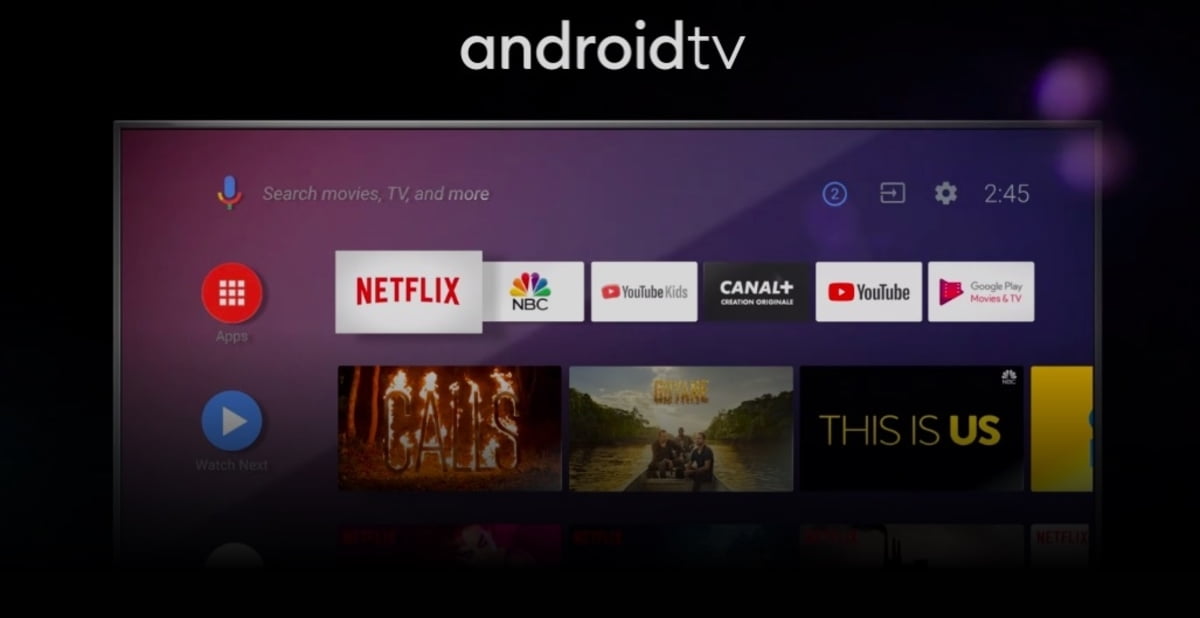
Android TVs are becoming a common sight in households all around the world. People are more excited about OTT platforms for watching content than the traditional cable TV way. Google is always working behind the scenes to make using Android a more seamless experience for its users. That is why Google keeps on sending updates to not only Android for smartphones but also for TV. Now Google has announced Gboard TV which is a virtual keyboard designed especially for Android TV. But along with that, Google has also introduced a new feature which will allow users to try the apps from the Android TV Play Store before they actually download them. Google Play Instant Support Now Available for Android TVsThe first time Google introduced Google Play Instant was in 2016. Now with the Google Play Instant available for Android TV, the users will be able to try the apps from Android TV Play Store before they actually install them. This solves the problem of the customers who want to save space on their storage by not installing unwanted apps on the TV. Along with that, it will also allow the users to determine whether they want to use the app in the first place or not. If they don't like it, they can simply ignore the app but if they do, then they can download it. Users will be able to see the 'Try Now' button beside the Install button for the apps on Android TV Play Store which are made available by its developers to be tried. But apart from that, Google has also introduced the Android TV emulator with Play Store support. It will allow the developers to test their apps on the Google Play Store before they release them. Another major addition that Google has brought to the Android TV experience is the 'PIN Code' support. Until now whenever someone wanted to purchase something from the Google Play Store, they would have to enter the full-length password for verifying the purchase. But that won't be the case anymore since users will be able to purchase and download anything they want simply by entering a four-digit PIN Code at the time of purchase. It will save users from the hassle of entering a long password every time. Along with this, users will also get the low-latency mode for enhancing their gaming experience on Android TV. Original article: Google Will Now Let Android TV Users Try Apps Before Installing Them ©2020 TelecomTalk. All Rights Reserved. |
| Samsung Galaxy Note 20 vs OnePlus 8 Pro Vs Mi 10: Which One Should You Buy? Posted: 11 Aug 2020 04:55 AM PDT This post first appeared on TelecomTalk Read more at: https://telecomtalk.info/samsung-galaxy-note-20-mi-comparison/289173/, Samsung Galaxy Note 20 vs OnePlus 8 Pro Vs Mi 10: Which One Should You Buy?
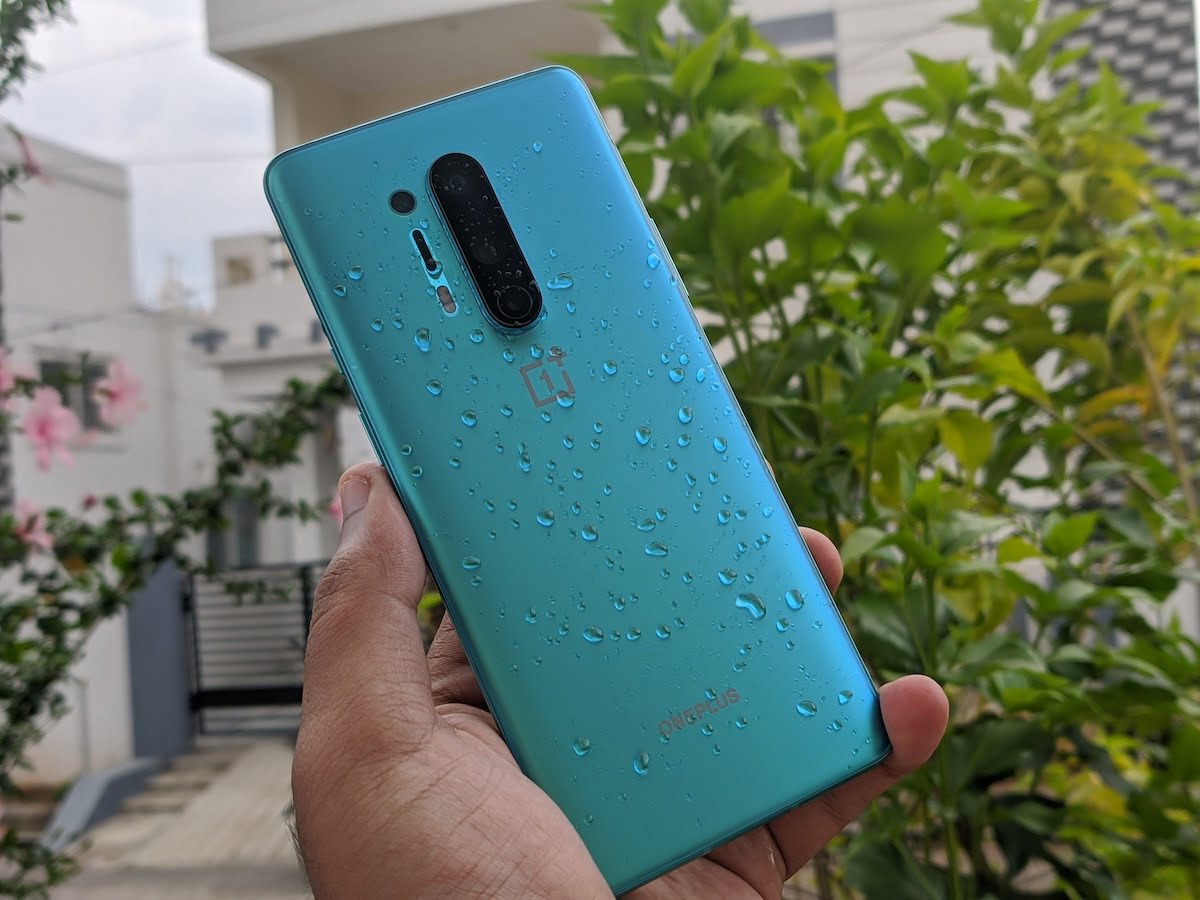
Last week Samsung unveiled a range of products in its online event. One of those products was its flagship device Galaxy Note 20. The Galaxy Note 20 is out for pre-sale in India at the moment and it comes with a triple-camera setup in the rear. Earlier this year, OnePlus and Xiaomi also launched their flagship devices — OnePlus 8 Pro and Mi 10. The pricing of both OnePlus 8 Pro and Mi 10 came as a surprise to many since they were launched at a much higher price than what people anticipated and expect from these particular brands. Let's compare these flagships and look at which one is the best! Samsung Galaxy Note 20 vs OnePlus 8 Pro Vs Mi 10: DisplayStarting with the Galaxy Note 20, it comes with a punch-hole display and has a 6.7-inch AMOLED screen with an in-display fingerprint scanner. It supports FHD+ resolution and 60Hz refresh rate. OnePlus 8 come with a punch-hole 6.7-inch AMOLED display with a fingerprint scanner in the screen as well. But compared to the Galaxy Note 20, it can support up to 120Hz refresh rate display and has QHD+ resolution. As for the Mi 10, it also comes with a 6.7-inch AMOLED screen with a punch-hole display. It can support 90Hz refresh rate display which is still more than the Galaxy Note 20 and has FHD+ resolution.
Samsung Galaxy Note 20 vs OnePlus 8 Pro Vs Mi 10: Software and SoC SpecificationsThe Galaxy Note 20 is powered by the company's own Exynos 990 SoC (for India). In the US and other selected international markets, the company is rolling out the Galaxy Note 20 with Snapdragon 865+ SoC. It is coupled with 8GB RAM and 256GB internal storage which is expandable with the help of microSD card. It runs Android 10 on top of OneUI 2.0 out of the box. As for the OnePlus 8 Pro, it comes with Snapdragon 865 5G SoC. There are two variants of the device with 8GB RAM and 12GB RAM which come with 128GB and 256GB internal storage respectively. The OnePlus 8 runs on Android 10 on top of OxygenOS 10. The Mi 10 is powered by the Snapdragon 865 SoC as well. However, both the variants of the smartphone only come with 8GB of RAM but with different storage options — 128GB and 256GB. It runs on Android 10 on top of MIUI 11. Samsung Galaxy Note 20 vs OnePlus 8 Pro Vs Mi 10: CameraThe Samsung Galaxy Note 20 comes with a triple camera setup in the rear. The primary sensor is a 12MP lens which is paired with a 64MP telephoto lens with 3x optical zoom and it can also support 30x space zoom. There is a 12MP ultra-wide-angle lens as well. For shooting selfies, there is a 10MP lens in the front. Coming to the OnePlus 8 Pro, you get a quad-camera setup. The primary camera of the lens has a 48MP sensor paired with a 48MP ultra-wide-angle sensor, 8MP telephoto lens, and a 5MP colour filter lens. You shoot videos in 4K at 30/60 fps. For selfies, there is A 16MP sensor in the front. The Mi 10 also has a quad-camera setup. Its primary sensor comes with a 108MP lens which is paired with a 13MP ultra-wide-angle sensor, a 2MP sensor, and a 2MP depth sensor. There is a 20MP sensor in the front for video calling and selfies. One of the unique features about the camera of Mi 10 is that it allows to shoot videos in 8K. Samsung Galaxy Note 20 vs OnePlus 8 Pro Vs Mi 10: Battery and ConnectivityThe Galaxy Note 20 comes with a 4,300mAh battery and 25W fast charging support. It also supports wireless charging 2.0 and reverse wireless charging. Even though it is not the biggest battery, the system is optimised to help it run the longest time possible. Coming to the OnePlus 8 Pro, you get a 4,510mAh battery which is not much bigger than the Galaxy Note 20 but it is also backed by a 30W fast charging tech. It can support wireless charging as well. OnePlus has claimed that the OnePlus 8 Pro can be charged from 0% to 50% in over 23 minutes. As for the Mi 10, it comes with a 4,780mAh battery. It also comes with a 30W fast charging support with wireless charging available. It has the biggest battery amongst the three which is a plus point for the smartphone. All the three smartphones have 5G connectivity along with 4G LTE, NFC and other basic connectivity options. Samsung Galaxy Note 20 vs OnePlus 8 Pro Vs Mi 10: Price and VerdictThe Samsung Galaxy Note 20 was launched very recently and the company is only offering one variant of the smartphone for pre-booking through its website in India. This variant of Galaxy Note 20 is 4G only and comes with 256GB of internal storage. It is available in three colour options Mystic Bronze, Mystic Green, and Mystic Blue and priced at Rs 77,999. The OnePlus 8 Pro which was launched quite a while back comes in two different variants. The first variant comes with 8GB+128GB and it is priced at Rs 54,999. The second variant of the smartphone comes with 12GB+256GB and it is priced at Rs 59,999. The smartphone is available in two different colours, Onyx Black and Glacial Green. It is selling through Amazon India and OnePlus India's official website as of now. Coming to the Mi 10, it is launched in two different variants as well. The first variant comes with 8GB+128GB and it is priced at Rs 49,999 and the second variant of the smartphone comes with 12GB+256GB and it is priced at Rs 54,999. The smartphone is available in two different colour options — Twilight Grey and Coral Green. Talking about which smartphone is the better option to buy. First of all, it depends on a given person's budget because here we have three smartphones which range from Rs 49,999 to Rs 77,999. But if we are talking about which smartphone is value for money, then Samsung Galaxy Note 20 clearly loses the race. The Galaxy Note 20 is priced at Rs 77,999 and doesn't even offer 5G connectivity. Then coming to the camera, it has a triple camera setup which is one camera lesser than both the OnePlus 8 Pro and Mi 10. On top of that, its primary camera has a 12MP lens. At the same time, OnePlus 8 Pro and Mi 10 have excellent cameras for the price range they are selling in. You can even shoot videos in 8K with the Mi 10. Overall, OnePlus 8 Pro is the best buy between the three if you are looking for the most utility out of your money. Yes, it doesn't come with a stylus, but most of the people don't need it in the first place. It can support 5G and compared to the MIUI and OneUI, OxygenOS is the clear winner. In terms of performance as well, OnePlus 8 Pro is a notch ahead of Mi 10. The best thing is, OnePlus 8 Pro is not too much expensive than the Mi 10 but it is very cheaper than the Samsung Galaxy Note 20. Original article: Samsung Galaxy Note 20 vs OnePlus 8 Pro Vs Mi 10: Which One Should You Buy? ©2020 TelecomTalk. All Rights Reserved. |
| BSNL Revamps FTTH and Broadband Plans, Users Complain About Plan Reversals Posted: 11 Aug 2020 03:32 AM PDT This post first appeared on TelecomTalk Read more at: https://telecomtalk.info/bsnl-revamps-ftth-broadband-plans/289152/, BSNL Revamps FTTH and Broadband Plans, Users Complain About Plan Reversals
Bharat Sanchar Nigam Limited (BSNL) on Tuesday revamped its broadband and Bharat Fiber plans for the Andaman and Nicobar Islands on a promotional basis. The development is on the heels of the Indian Prime Minister Narendra Modi inaugurating the submarine Optical Fiber Cable (OFC) connectivity between Chennai and Andman and Nicobar Islands on Monday. The OFC connecting Chennai and Port Blair is said to deliver 2x 200 Gbps between the two cities and 2×100 Gbps between Port Blair and other islands. BSNL on Sunday announced a "bonza in terms of high internet speed and multiple times increase in volume of data downloads to all its wireline and mobile customers in the islands." Several BSNL Users Report No Enhancements to Existing PlansWhile several BSNL users on Twitter including T.K.Jijith Rekh, state spokesperson of BJP Andaman and Nicobar Islands reported an increase in download speeds, others reported no enhancements to their existing plans. Further, certain BSNL users who had initially noticed improvements on their plan later highlighted that their plan details have "reversed after midnight" on the BSNL portal with these users also reporting dip in speeds. It has to be noted that BSNL was earlier scheduled to revamp its broadband and Bharat Fiber plans in the Andman and Nicobar on July 1. However, the operator pushed back the revamp of its plans that was tied to the CANI project to August. Similar to its current scenario, multiple BSNL users in July had initially noticed changes to their plans, only to later report that BSNL "reversed" the plan details on the portal.
Unlike the previous month where BSNL issued notifications through flyers in the region about the plan change, BSNL has now updated the revamped plans on the dedicated Andaman and Nicobar section of its website. Rohit Singh, a BSNL broadband user in Port Blair said that the BSNL portal had initially reflected the new enhanced plan only for the operator to reverse it in the night. Singh said that he uses multiple internet connections each month including three ADSL and one Fibre-to-the-Home (FTTH) connection. As part of the BSNL revamp, Singh told TelecomTalk that BSNL on one of his connections should have upgraded him from the 4 Mbps till 25GB per month plan to the daily 10GB plan. While BSNL initially enhanced him to the daily 10GB plan, Singh said that the operator reverted him to his old plan that offers 25GB per month. Singh said that he is now worried about the data overages on his DSL connection. "Even the billing dept is not sure how they will bill for this month," Singh told TelecomTalk. Singh said that he moved to his hometown Port Blair due to the COVID-19 lockdown in March and that he pays over Rs 10,000 per month on the internet connections. "I myself working for a Telecom giant, who manufacture 5G devices," Singh said. "Working in such environments is the worse [sic]." Singh said that the revamped BSNL plans with enhanced speeds were initially supposed to launch in March but that the project was pushed back due to COVID-19. "Many VIP areas were getting good speed via OFC," Singh said. "I could see it by the ping statistics. Later when [the] cyclone came it was a complete collapse and they unofficially switched to OFC but didn’t launch, I used to work from [the] road in the nights where the Mobile speeds were good, later got 1 Mbps speed when they switched." Singh said that the users in Andaman and Nicobar had to pay 10 times more on the internet connections as compared to the users in mainland. Crucially, Singh said that the expensive internet in the Andman and Nicobar region has hurt the students as they couldn't afford the internet and had lost the online classes. "I even gave [the] internet as [and] when possible to few students whenever it was available," Singh said. "The amount spent over [the] internet is equal to paying for a new bike or atleast car down payment." It remains to be seen if BSNL enables the enhanced plan to all the users on the island or permanently switches back to the old plans. However, as noted, BSNL has updated the new plans on its website on a promotional basis. BSNL Unveils Revamped ADSL Broadband Plans in Andaman and NicobarAccording to the BSNL site, the state-run operator will offer eight enhanced broadband plans on a promotional basis till November 7, 2020. BSNL highlighted that the base plan priced at Rs 350 per month will be enhanced from up to 2 Mbps speed with 2GB data limit to 4 Mbps speed till 30GB. The Rs 650 plan that offered up to 2 Mbps speed till 4GB is said to be enhanced to up to 8 Mbps speed till 60GB. Further, the Rs 1000 plan that offers up to 2 Mbps speed till 10GB is said to receive an enhancement to up to 10 Mbps speed till 120GB. The operator has highlighted that the Rs 350, Rs 650 and the Rs 1000 plans will all continue to have the post fair usage policy (FUP) speeds of 512 Kbps. BSNL has also enhanced the Rs 1750 plan that previously offered up to 4 Mbps speed till 25GB per month to up to 10 Mbps speed till 10GB per day. It was said that the operator caps the speeds to 1 Mbps upon reaching the limit on the Rs 1750 plan. The Rs 2750 plan that earlier offered up to 4 Mbps speed till 50GB per month is said to be enhanced to up to 10 Mbps to 15GB per day. Further, the Rs 3750 plan that enabled users to browse up to 4 Mbps speed till 80GB is said to be enhanced to up to 10 Mbps up till 25GB per day. BSNL highlighted that the users on the Rs 2750 plan and the Rs 3750 plan will have a post FUP speed of 2 Mbps. The operator also noted that the top tier ADSL plans priced at Rs 5000 and Rs 7500 per month has also been enhanced to offer higher speeds and data limits.  The Rs 5000 plan that earlier offered up to 4 Mbps speed till 125GB per month is said to be enhanced to up to 10 Mbps speed till 35GB per day. Further, the Rs 7500 plan that offered up to 4 Mbps speed till 225GB per month is said to be enhanced to be enhanced to up to 10 Mbps speed till 50GB per day. BSNL highlighted that the post FUP speeds on the Rs 5000 and Rs 7500 plan will be 2 Mbps, up from 512 kbps earlier. While BSNL has retained the existing charges on the landline, the operator has crucially stopped the data overage charges on the new enhanced ADSL broadband plans. BSNL Enhances Bharat Fiber Plans in Andaman and NicobarThe state-run operator offers seven Bharat Fiber plans in the region with BSNL highlighting that the plans would all be enhanced with higher speeds and data limits. The base Rs 799 Bharat Fiber FTTH plan is said to be enhanced from up to 10 Mbps speed till 4GB to up to 10 Mbps speed till 60GB. Further, the Rs 999 plan is said to be enhanced from up to 10 Mbps speed till 8GB to up to 10 Mbps speed till 150GB. BSNL highlights that the users on the Rs 799 plan and the Rs 999 plan will continue to have an post FUP speed of 512 Kbps. The Rs 1899 plan that earlier offered up to 10 Mbps speed till 25GB per month is said to be enhanced to up 10 Mbps speed till 10GB per day. BSNL said that the users subscribed to Rs 1799 plan will have a post FUP speed of 1 Mbps, up from 512 Kbps. The Rs 2799 plan is said to be enhanced from up to 10 Mbps speed till 45GB per month to 30 Mbps speed till 15GB per day. Further, the Rs 3999 plan is said to be enhanced from up to 10 Mbps speed till 80GB to up to 50 Mbps speed till 25GB per day. BSNL said that the users on the Rs 2799 and the Rs 3799 plan will have a post FUP speed of 2 Mbps as compared to earlier speed of 512 Kbps. The operator is also enhancing the speed and data limit on its top tier Bharat Fiber FTTH plans priced at Rs 5999 and Rs 7999 per month. The Rs 5999 plan is said to be enhanced to up to 80 Mbps speed till 40GB per day from 10 Mbps speed till 140GB per month. Further, the operator said that the Rs 7999 plan will now offer 100 Mbps speed till 50GB per day as compared to 10 Mbps speed till 225GB per month. The post FUP speeds of the Rs 5999 and the Rs 7999 plan is said to be 4 Mbps as compared to earlier speed of 512 Kbps. Similar to its ADSL broadband plans, the enhanced Bharat Fiber plans are valid till November 7, 2020 with BSNL also eliminating the data overages on its revamped Bharat Fiber FTTH plans. Original article: BSNL Revamps FTTH and Broadband Plans, Users Complain About Plan Reversals ©2020 TelecomTalk. All Rights Reserved. |
| WhatsApp Future Update to Include Chat Sync Across Multiple Platforms Posted: 11 Aug 2020 01:51 AM PDT This post first appeared on TelecomTalk Read more at: https://telecomtalk.info/whatsapp-future-update-chat-sync/289100/, WhatsApp Future Update to Include Chat Sync Across Multiple Platforms
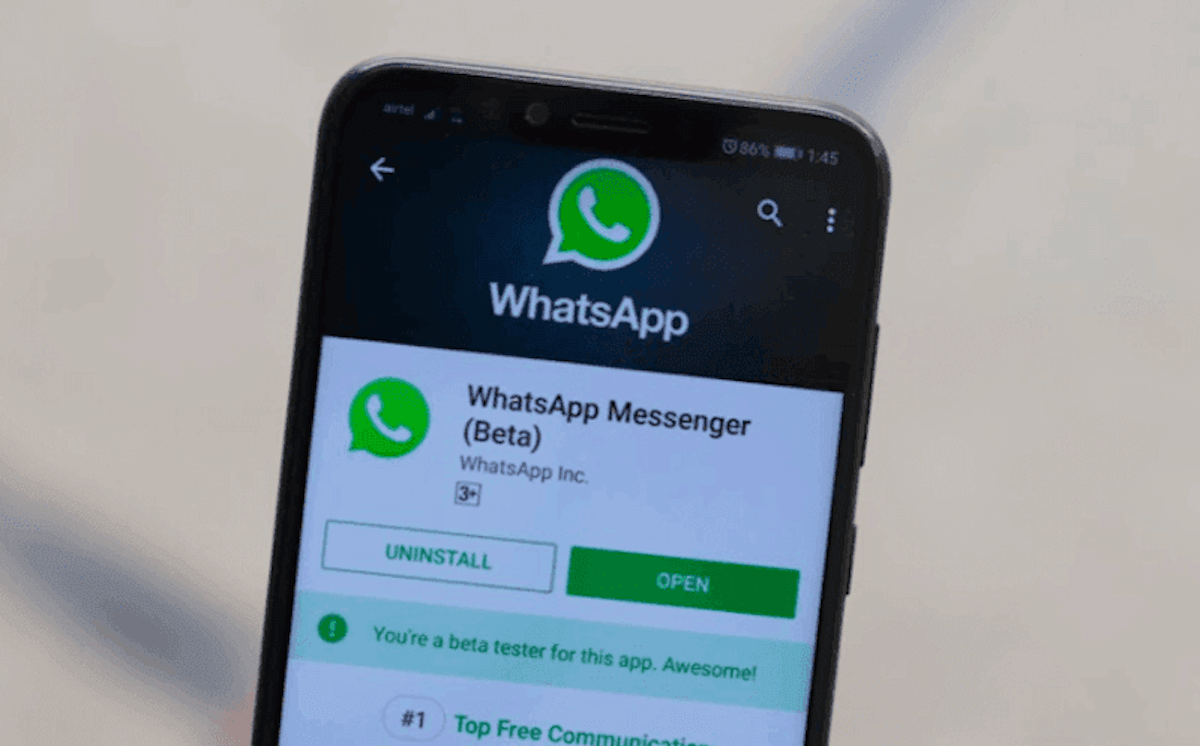
WhatsApp is easily one of the biggest social media platforms in the world. It has more than billion active monthly users. It allows users to connect with other people in a very convenient way. There are no limits to distance, you can sit in one part of the world and text to someone living in the other part, all that is needed is an internet connection. But one feature that a lot of people have been asking for is to be able to use WhatsApp in different devices at the same time. Not just like WhatsApp Web where you have to scan it and then use it, but like you do with Facebook, Instagram and more social media apps. Alongside that, WhatsApp is also said to be working on a feature which will allow chat sync across multiple platforms. WhatsApp Working on Allowing Simultaneous Logins in 4 Different DevicesWhatsApp doesn't work in any other smartphone if you are using it in one. As per WABetaInfo, WhatsApp is working on a feature which will sync the chat history across all the devices. The feature to use WhatsApp in different devices hasn't happened yet because the app has been used in a single device so far and thus it will take time to implement this new feature. How this feature will work is when an user switches his smartphone to use WhatsApp in a different one, all the data will be synchronised from one device to the other. It would be preferable if the user is connected to a Wi-Fi network at the time of synchronisation because downloading of chats can take a significant amount of data. For now WhatsApp is said to be testing the feature on its desktop app. It is quite possible that this new feature is first rolled out for the WhatsApp Web rather than the mobile app. When this happens, you won't require your smartphone's WhatsApp to be working to use the WhatsApp Web. Once you are using the WhatsApp Web, you can switch off your smartphone and still be able to use it on your desktop. A message delivered to one of your devices will be delivered to all of the devices. When you remove or use a device, the encryption key will change. Original article: WhatsApp Future Update to Include Chat Sync Across Multiple Platforms ©2020 TelecomTalk. All Rights Reserved. |
| Airtel BlueJeans Video Conferencing App: Features We Like Posted: 11 Aug 2020 12:04 AM PDT This post first appeared on TelecomTalk Read more at: https://telecomtalk.info/airtel-bluejeans-video-conferencing-features/288939/, Airtel BlueJeans Video Conferencing App: Features We Like
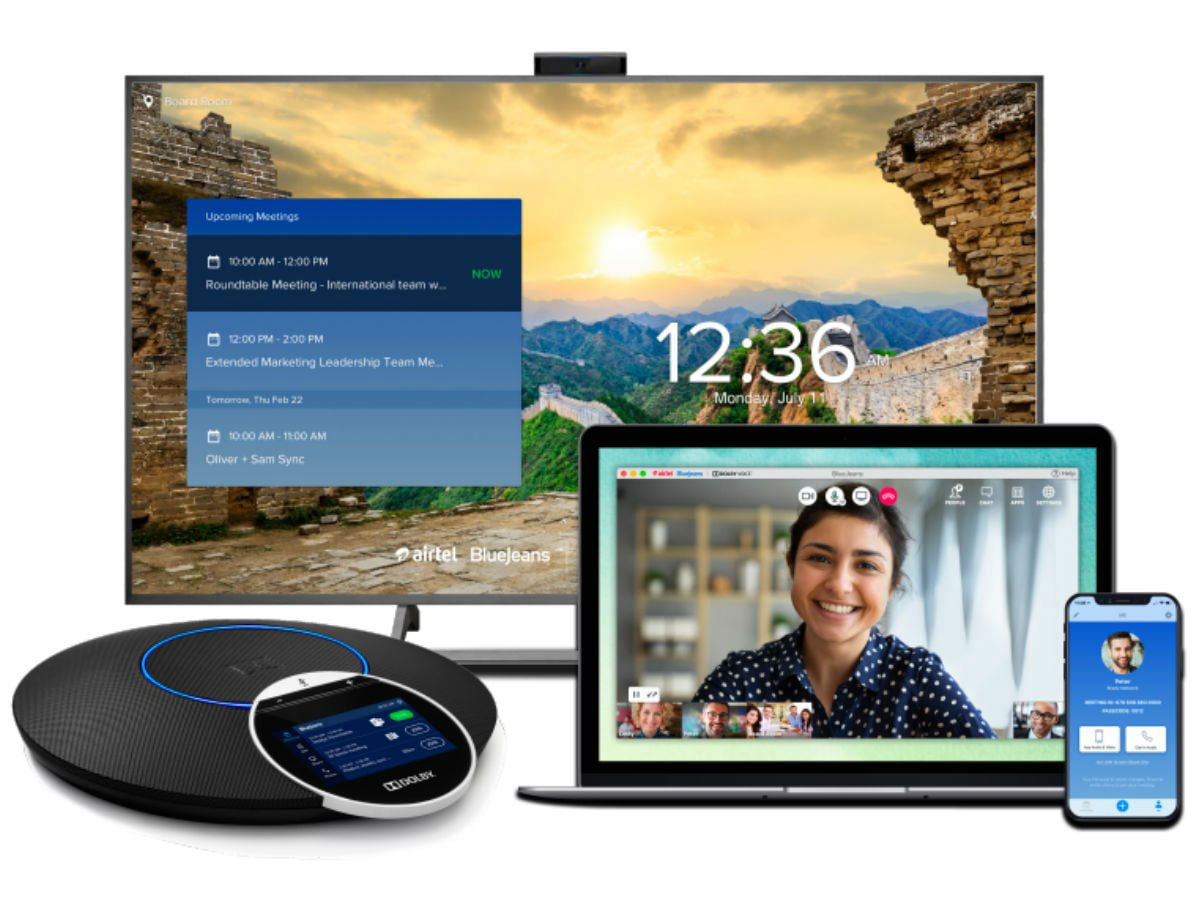
The video conferencing apps have taken the spotlight in India and in many other countries across the world due to COVID-19 pandemic. Several companies in India and abroad have enforced Work-from-Home policies from March that resulted in a spike in downloads of remote work and video conferencing apps on the Google Play and App Store. While many expected Skype to thrive in the conditions custom made for the app, it was the Zoom Video Conferencing that emerged as default go-to app for many people around the world. Video Conferencing App Emerges as Everyone's Favourite App During COVID-19Sensor Tower, a company that offers market insights on global app economy, said in its second quarter Data Digest report that Zoom emerged as the top app by downloads on a global scale. It was said that Zoom was only the third app to hit 300 million installs in a quarter, joining TikTok and Pokemon GO. Sensor Tower said that Zoom "shattered the record" for App Store installs with nearly 94 million installs in a quarter. Further, Zoom installs on Google Play is said to have increased 200% quarter-over-quarter. In India, Sensor Tower said that Zoom had over 68 million installs while the app witnessed 41 million installs in the US market in the second quarter ended June 30, 2020. While on paper, Zoom covered all the bases by emerging as the default go-to app for video conferencing solution, the company behind the scenes had to deal with privacy issues. In late March, it emerged that Zoom app doesn't support end-to-end encryption even as Zoom stated on its website that it supports such a protocol. The end-to-end encryption ensures that conversations are protected with no access to anyone including that of a company and is found on platforms like WhatsApp and Signal. In April, the Indian government in an advisory said that the Zoom "is not for use by Government officers/officials for official purposes." Additionally, the union Ministry of Home Affairs (MHA) issued guidelines to private individuals for using the Zoom app. With that, several other players entered the fray with a new product or expanded the capabilities of their existing product to grab the market share from Zoom including Google and Jio Platforms. Google in May said that its Google Meet, originally designed to offer "secure business meetings" would be available for everyone for free. The company in May said that it hosts three billion minutes of video meetings each single day on its Google Meet platform. Jio Platforms, the holding company of Indian telecom operator Reliance Jio officially launched its JioMeet platform in early July after months of testing. Following the launch of JioMeet, several users took to social media to point out the similarities between JioMeet and Zoom Video Conferencing app. The similarities between the JioMeet and Zoom app included identical landing screen and identical design of the Meeting pages along with Contacts, About page and My Profile section. Additionally, JioMeet highlighted that the app collects personal information such as "name, age, gender, contact information, products and services you are interested in" from an user. Further, the developers highlighted that the data collected by JioMeet will be shared with "affiliates" along with "external organizations" and "individuals." Airtel Enters the Fray with BlueJeans Video Conferencing AppWith the market seemingly open to additional players, Airtel in mid July announced a strategic alliance with Verizon, New York based communications company to introduce BlueJeans Video conferencing app in India. BlueJeans, Verizon's "enterprise-grade video conferencing service" is said to aid people in communicating and collaborating across mobile, desktop, browser and conference rooms. Airtel sad that India is "witnessing a massive surge in demand for enterprise grade video conferencing tools as Work From Home and virtual meetings become the new normal." The company said that the alliance between Airtel and Verizon will "address the need for seamless and secure business collaboration as organizations move from office-based work to work from anywhere." "BlueJeans' enterprise-level security features include meeting lock, secure transmission and storage, randomized meeting IDs, participant passcodes, fraud detection, and a variety of authentication options," Airtel said in a release in July. "The platform uses open, proven standards for security as well as the WebRTC and HTML5 standards for browser-based access, enabling users to participate in meetings and events without requiring software downloads, a key requirement in some secure environments." BlueJeans Delivers on Security PromiseWhile the words from Airtel and Verizon on the "enterprise-level security" sounds great on paper, Mozilla Foundation in a report said that "BlueJeans seems to do a fine job with security." Mozilla, a not-for-profit organization behind the Firefox browser said in April that BlueJeans was among the 12 video conferencing apps that met its minimum security standards. "It doesn’t use end-to-end encryption, but it still uses strong encryption and has the ability to require passwords to access meeting to stop the dreaded 'zoombombing'," Mozilla Foundation said on the BlueJeans app. Crucially, Airtel also highlights that the data transmitted through the Airtel BlueJeans app is hosted locally in India "for a better video conferencing experience." Airtel Promises Dolby Audio and HD Video with Airtel BlueJeans AppAirtel highlights that Airtel BlueJeans delivers Dolby Voice along with high-definition (HD) video with the app providing "award-winning multimedia experience" that ensures users witness "amazing audio and visual clarity."
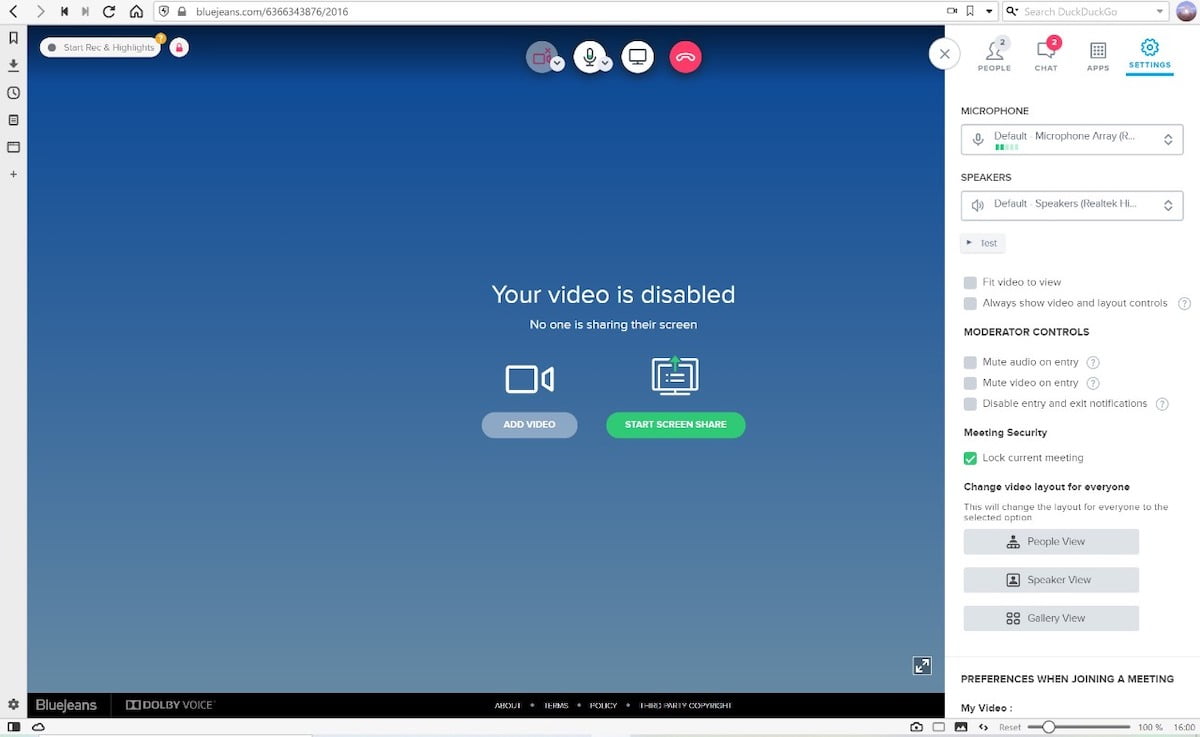
During our time with the Airtel BlueJeans app, the app did produce higher quality video and audio experience as compared to its rivals. Multiple BlueJeans users told this writer on Twitter that the app is the "best amongst all" and that it delivers "crystal clear sound and great video." The app also features a low bandwidth mode that is designed to aid those users on the mobile data. Airtel Promises Simplicity with BlueJeans AppThe company highlights that the Airtel BlueJeans app enables "users to schedule, join and host meetings with one touch and within just six seconds from anywhere, on any device." It has to be noted that the app is designed for enterprise users and not for consumers. While the regular consumer focused video conferencing app provides real simplicity for regular consumers, the enterprise users on the BlueJeans app can schedule meetings at a rapid pace. The homescreen on the Airtel BlueJeans app offers users to schedule a meeting, join a meeting or start a meeting. The users hoping to schedule a meeting need to select the relevant option and enter the meeting title, add a description, select the time slot and enter the email addresses of the participants. The users can also schedule and join a meeting with Meeting ID and Participant Passcode.
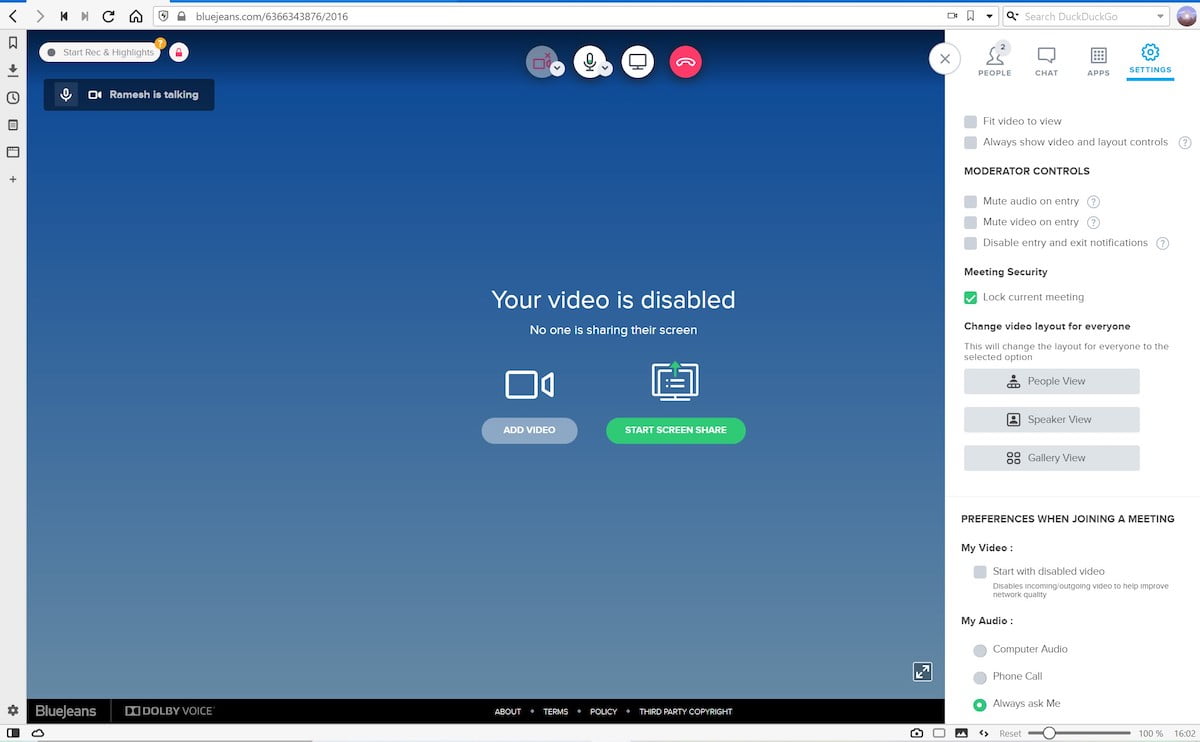
The hosts also have an array of controls including selecting a people view layout, enabling auto-recording, screen share, crop video and disable chat messaging. Additionally, the hosts can also mute participants automatically on entry and turn off participant's video on entry automatically. The standard features like muting a participant’s audio and video during a meeting are also available on the Airtel BlueJeans app. The screen share feature is also available on desktop and mobile app variants with the participants having the features to share the complete screen or a particular desktop tab. It is said that the Airtel BlueJeans enables users to host and manage live interactive events, town halls and webcasts for up to 50,000 attendees. Further, the Airtel BlueJeans enables users to launch or join meetings directly from a variety of applications including Microsoft Teams, Workplace by Facebook,Office 365, Google Calendar, Slack, Splunk and Trello. The Smart Meetings feature enables participants to highlight specific moments in the meetings for the app to capture the "most important discussion points" for users to catch-up quickly on a meeting. The company also has "Dial-in Plans" that is designed to cut down on India dial-in cost with Airtel promising "unmatched coverage" through "convenient dial-in options" for over 120 countries. Airtel BlueJeans Emerges as Default Option for Enterprise UsersFrom a regular consumer point of view, the Airtel BlueJeans might not sound as a tempting option considering the number of alternatives already present in the space. While the app does offer a free trial of 90 days for new users, the enterprise BlueJeans users will have to switch over to custom curated plans post the free period. Several standard features including screen sharing that are often found on other video conferencing apps are more seamless elsewhere than on the Airtel BlueJeans apps. However, as noted by regular BlueJeans users on Twitter, the app now emerges as a default go-to video conferencing app for the enterprise users due to its clean interface and security features. The app design is minimal and clean and the enterprise users swamped with multiple tasks would prefer this over the rival apps. Airtel also offers "fully managed 24×7 support services" for the Airtel BlueJeans app that enables enterprise users to troubleshoot the problems at a rapid pace as compared to several other rival apps. Original article: Airtel BlueJeans Video Conferencing App: Features We Like ©2020 TelecomTalk. All Rights Reserved. |
| Top Video Conferencing App Solutions for India in 2020 Posted: 10 Aug 2020 10:17 PM PDT This post first appeared on TelecomTalk Read more at: https://telecomtalk.info/video-conferencing-app-solutions-india/288892/, Top Video Conferencing App Solutions for India in 2020
Video conferencing has become the backbone of nearly every industry for conducting meetings, seminars or classes. Since the government announced a lockdown period to tackle the deadly virus, work from home became the new normal. Nearly every corporate organisation announced work from home for employees to ensure complete safety. Not only this, but school and colleges started taking online classes. The Covid-19 scare resulted in the growth of various video conferencing apps to cater to the different needs of customers. Some of the apps have made its space in the video calls segment, whereas various big companies have recently developed their video conferencing apps to capture the new rising market. In this article, we will cover 5 different video conferencing apps which will be the perfect choice for your next online class or meeting. Zoom AppZoom app gained the limelight when the government announced the lockdown period to combat the deadly virus. Zoom app is widely used by enterprises and individuals for personal and corporate meetings. The app is specially developed and aimed for enterprise users with an attractive free option. Zoom supports up to 100 participants. However, if the free user’s conference includes more than 3 individuals, the call duration will be limited to 40 minutes. Zoom allows users to do video calls using a browser, dedicated apps and extensions. Even though Zoom is highly used, the app faced a backlash from various government authorities. The app was said to be leaking private data of its users. Even the government of India stated that Zoom is not a safe platform for users. However, the app is being used by a major chunk of users in India. JioMeet AppAs soon as the news broke out that Zoom app is not safe for users, Reliance Jio announced its own video conferencing app JioMeet to capture the market share of Zoom. However, Reliance Jio is not new in the video conferencing segment. Earlier, it introduced JioChat app, which allowed video call features to users. Now JioMeet app is specially designed to cater to the video calling need of users in challenging times. JioMeet app is available across all platforms, and it allows HD video conferencing in all the devices.
BlueJeans AppSince JioMeet, Zoom and other video conferencing apps were extensively growing, Airtel also dived in the competition and launched its video conferencing app BlueJeans. For the app, Airtel partnered up with US-based Verizon-owned BlueJeans to launch its video conferencing app in India. BlueJeans app is equipped with high-graded security features, and it can be accessed via browsers which will eliminate the need of downloading the app. Also, on a single call user can add up to 50,000 participants. Google Duo AppGoogle Duo app is one of the most renowned video conferencing platforms which allows video calling facility to users. However, the rival competitive video calling apps like Zoom, JioMeet and many more were offering higher participants in a single video call. Recently, to eliminate the competition, Googe Duo also increased the participation in a single video call. Not only this, but Google Duo has also announced various new features in the app for a smooth and hassle-free video calling. Skype AppSkype is one of the most famous and oldest VoIP apps, which allows video conferencing for up to 50 participants. The company launched the expanded features of the app back in 2019 and improved on various old features. Now, Skype allows unlimited video calling to a maximum of 50 participants. All the users can join the meeting from a web browser on a computer. They can also join the meeting using the Skype app. Original article: Top Video Conferencing App Solutions for India in 2020 ©2020 TelecomTalk. All Rights Reserved. |
| Low-Cost Postpaid Plans from Bharti Airtel, Vodafone and Reliance Jio Posted: 10 Aug 2020 06:37 PM PDT This post first appeared on TelecomTalk Read more at: https://telecomtalk.info/low-cost-postpaid-plans-august-2020/288967/, Low-Cost Postpaid Plans from Bharti Airtel, Vodafone and Reliance Jio
Postpaid plans are the way to go if you truly want a seamless mobile connection. Not taking anything away from prepaid plans, but postpaid plans just provide better value to some people. Telcos have innovated in their own way with the postpaid plans. Vodafone, for example, offers RED Family plans wherein different members of the family can use a postpaid connection, get calling and data benefits, and all of it will be grouped under a single bill. Let's take a look at the low-cost postpaid plans from some of the major telcos. Bharti AirtelAirtel offers its low-cost postpaid plan for Rs 499 monthly and it comes with 75GB data benefit. The best thing is that there is an option for data rollover once you have exhausted your initial 75GB data. You get unlimited calling benefit to any network. Along with that, there is a free one-year subscription to Amazon Prime and Airtel Xstream App. There is also handset protection included in the plan. Airtel has removed its ZEE5 Premium offering with the plan though. With the plan you will also be included in the Platinum membership of Airtel Thanks programme. With the Platinum membership, you will get benefits such as VIP Service, 1-year subscription from Shaw Academy, Wynk Premium, and Free Hellotunes. However, unlike all the other postpaid plans from Airtel, this one doesn't come with additional connections which you can share with your friends or family. Reliance JioJio is offering only one plan under its postpaid plans category. It comes for Rs 199. With the plan, you will get a total of 25GB data only. After you have exhausted your initial 25GB data, for every additional GB of data that you consume, you will be charged Rs 20. There is an unlimited voice calling to any network you wish too included as well. Along with that, there is a 100 SMS/day benefit. You also get a complimentary subscription to all the Jio apps. VodafoneVodafone offers some of the best postpaid plans amongst all the telcos. Its Rs 399 plan is low-cost for an individual. With the plan, the user gets 40GB of data initially with a data rollover facility of up to 200GB. There is unlimited calling to any network included with 100 SMS/day. Coming to the OTT benefits of the plan, you get a free Vodafone Play subscription worth Rs 499 for one year and along with that, there is also ZEE5 Premium worth Rs 999 totally for free. But then there is a separate category of family plans as well. The low-cost postpaid family plan comes for Rs 598. There are two connections in this one (primary + secondary). 80GB data is offered out of which the primary user gets 50GB data and the secondary user gets 30GB data with a data rollover facility of 200GB. OTT benefits are Vodafone Play, Amazon Prime, and ZEE5 Premium. Original article: Low-Cost Postpaid Plans from Bharti Airtel, Vodafone and Reliance Jio ©2020 TelecomTalk. All Rights Reserved. |





| You are subscribed to email updates from TelecomTalk. To stop receiving these emails, you may unsubscribe now. | Email delivery powered by Google |
| Google, 1600 Amphitheatre Parkway, Mountain View, CA 94043, United States | |


Comments
Post a Comment