${latestitem Title}
${latestitem Title} |
- Tata Sky Brings Smart Guide Feature to its SD and HD Set-Top Boxes
- Jio Ahead of Vi and Airtel in Delivering Better Play Start Time (PST) and Video Rebuffering Rate: Mozark
- Telecom Operators Yet to See Pre COVID-19 Activity Levels
- Bharti Airtel Offering Best Gaming Experience in India Followed by Vi: OpenSignal
- Tata Sky Introduces 200 Mbps Broadband Plan, Revises 300 Mbps Plan Price
- Tata Sky to Revise EPG Numbers of Over 20 Bengali Channels
- Xiaomi Mi 10T and Mi 10T Pro Complete Specs Leaked Online Ahead of Launch
- JioFiber, Airtel Xstream Fiber and BSNL Bharat Fiber Cheapest Broadband Plans Compared
| Tata Sky Brings Smart Guide Feature to its SD and HD Set-Top Boxes Posted: 28 Sep 2020 06:53 AM PDT This post first appeared on TelecomTalk Read more at: https://telecomtalk.info/tatasky-smart-guide-feature-stbs/301040/, Tata Sky Brings Smart Guide Feature to its SD and HD Set-Top Boxes
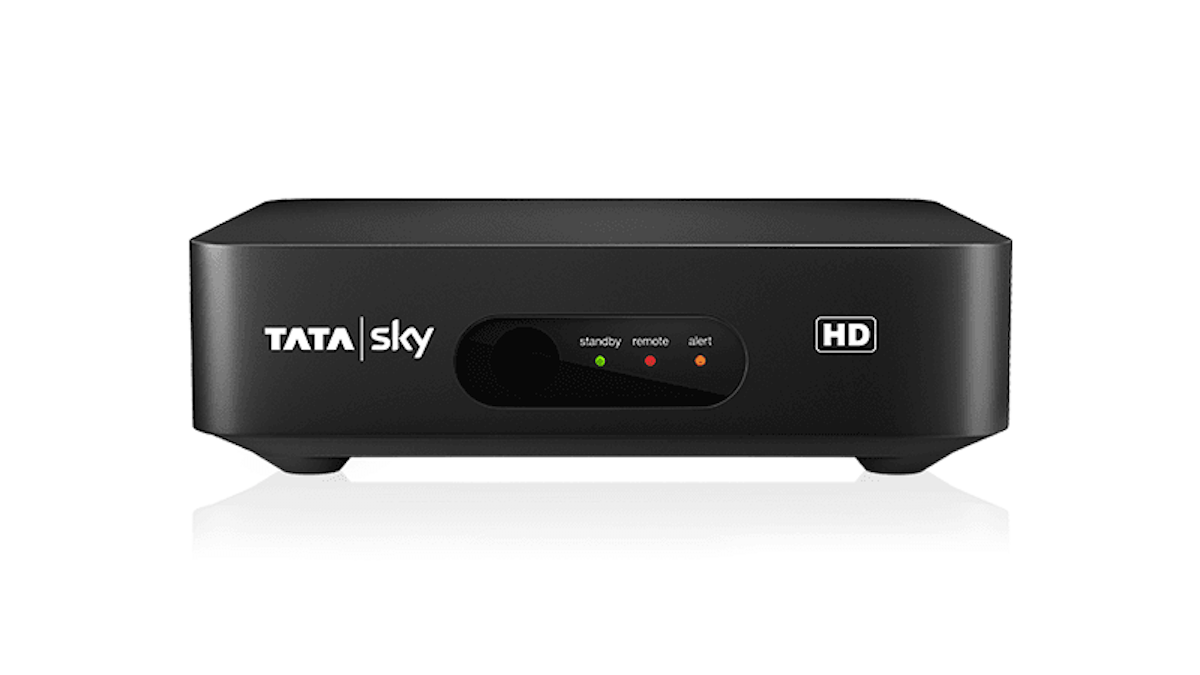
Tata Sky has constantly been adding new features to its Set-Top Boxes. Today, the leading DTH operator announced a new feature called ‘Smart Guide,’ for its existing SD and HD Set-Top Box users. Smart Guide by Tata Sky enables the users to discover and consume content on television in a smart way. The company has announced this feature in collaboration with Pay TV. Tata Sky also enhanced the linear search functionality on its STBs. It is good to see Tata Sky adding new features to the basic Standard Definition (SD) and High Definition (HD) STBs. A press release from Tata Sky also confirmed the new feature has been rolled out to more than 15 million STBs across India. Tata Sky ‘Smart Guide’ for STBs: What Exactly Is ItAs mentioned above, Tata Sky Smart Guide will allow the existing SD and HD STB users to discover content. Smart Guide will display content recommendations and they can be easily accessed through the newly revamped Guide button on the Tata Sky remote. The channel guide screen offers thumbnail views of the most-watched channels, genres and platform services by the subscribers, under the banners – 'Your Top Channels', 'Trending Channels', 'Favourite Genre' etc. based on a subscriber's viewing history and the time spent viewing a particular channel or genre. The feature not only gives quick access to the most viewed channels but also recommends more channels based on the genres viewers like to watch. In the case of multi-connection homes, recommendations will be different for the primary and secondary Set-Top Box in line with individual preferences. As we all know, Tata Sky’s basic SD and HD STBs do not offer internet connectivity, so the recommendations will be of linear TV channels. Furthermore, Tata Sky also enhanced the Linear Search feature to enable subscribers to search for channels via channel name, offering a hassle-free way of switching to their favourite channel. Tata Sky users can activate the Linear search directly from the banner, guide grid and full-screen video by only pressing the '0' button on the remote, thereby offering subscribers a faster option to discover their preferred content. More than 15 million STBs from Tata Sky have received the new Smart Guide feature. Original article: Tata Sky Brings Smart Guide Feature to its SD and HD Set-Top Boxes ©2020 TelecomTalk. All Rights Reserved. |
| Posted: 28 Sep 2020 05:34 AM PDT This post first appeared on TelecomTalk Read more at: https://telecomtalk.info/jio-vi-airtel-mozark-india/300950/, Jio Ahead of Vi and Airtel in Delivering Better Play Start Time (PST) and Video Rebuffering Rate: Mozark
There is always a question in the mind of users, ‘which telco is the best in terms of providing a strong network experience?’ When users talk about network experience, they are often concerned with the kind of speed they are getting. But the download/upload speed is not everything that a user should be talking about. Mozark in a report offered its views on what a network operator should focus on in terms of enhancing network experience. The company utilises "cutting edge" technology to measure the performance of the service delivered to the end users. Mozark is said to be often engaged with telecom operators, building owners and others to enhance quality of experience delivered to users. The company said that the play start time and video rebuffering rate are two of the most important metrics for understanding how good a network actually is in providing a good video streaming experience to the user. More on the story ahead. Better PST and Video Rebuffering Rate Seen with Jio Compared to Vi and AirtelIn its study, Mozark recorded the data in a way which helped it measure the actual app experience that a user goes through without changing any of the codes or SDK integrations. The company is said to have used AI-enabled bots which commanded the smartphone in the same way an average human user would. Mozark focused on two key things for the test, a) play start time (PST), and b) video rebuffering rate. For checking the video rebuffering rate, every test included playing a video for 60 seconds and then measuring the percentage of time which was taken to buffer the video. To conduct this test, Mozark is said to have used six Over-the-Top (OTT) applications including YouTube, Disney+ Hotstar, Netflix, SonyLIV, ZEE5, and Voot. The company is said to have conducted the test on the networks of Jio, Vi (Vodafone Idea), and Bharti Airtel. According to Mozark, the test showed three key results. Firstly, 14 Mbps speed is what the network operators should look for providing to each of its users. Because it can deliver the result of PST (play start time) under 4 seconds which is how a lot of users want it to be. This result was similar across all the networks. Further, it was discovered that the PST is the most sensitive to fall steeply when the network speed falls under 5 Mbps. However, when the network goes above 5 Mbps, the improvement in PST is said to remain quite flat. From the study, it was found that Jio provided users with a better PST and video rebuffering rate on the same network speed as compared to operators. Airtel and Vodafone showed quite similar results with Airtel said to be marginally ahead of Vi. Relationship Between Apps and Operators NecessaryThe second result of the study suggested that a close relationship between apps and the network operators is necessary. The study highlights that the apps such as YouTube and Disney+ Hotstar performed better when the speed wasn't that great but with Netflix, the quality of experience for the user fell quite steeply. So the app developers and companies need to look at how they can improve the app overall so that it needs less and less network speed to perform better. This could require a heavy investment in the delivery network amongst other things. The third result of the study conducted by Mozark suggested that the Indian telecom space is far away from delivering the MOT (minimum operating threshold) network speed which is required for ideal video experience. Only 20% of the samples could touch the MOT network speed of 14 Mbps which clearly means that more investments are required by the sector to improve its performance. Mozark concluded the study by suggesting that the network operators must understand the MOT network speed required for each use case. The use case taken for this study was video streaming. But it was said that there are many other use cases as well. It is high time for the network operators to start focusing on the metrics which matter rather than the metrics which are easy to measure. Original article: Jio Ahead of Vi and Airtel in Delivering Better Play Start Time (PST) and Video Rebuffering Rate: Mozark ©2020 TelecomTalk. All Rights Reserved. |
| Telecom Operators Yet to See Pre COVID-19 Activity Levels Posted: 28 Sep 2020 04:17 AM PDT This post first appeared on TelecomTalk Read more at: https://telecomtalk.info/telecom-operators-pre-covid-19-activity/300997/, Telecom Operators Yet to See Pre COVID-19 Activity Levels
The Indian telecom operators including Reliance Jio and Bharti Airtel have not seen the pre COVID-19 activity levels on their network, Motilal Oswal said in a report on Thursday. The firm engaged in the financial services in a report reflected on the Telecom Subscription Data released by the Telecom Regulatory Authority of India (TRAI) for June, 2020. The data released by TRAI highlights that the telecom industry lost 3.2 million subscribers in June, 2020 with the telecom operators now having a combined gross subscriber base of 1.14 billion. Telecom Operators Continue to Lose SubscribersMotilal Oswal highlighted that the June, 2020, was the fourth consecutive month of the telecom industry witnessing a decline in gross subscriber base "due to COVID-19 crisis." Vodafone Idea is said to have lost around 4.8 million subscribers while Airtel lost around 1.1 million users in June, 2020. However, Trai data highlights that Reliance Jio added around 4.5 million users in June, 2020. The firm also said that the industry witnessed 2.8 million active subscriber churn in June, 2020 to reach 958 million users. "Thus, the benefit of limited recovery that happened in May'20 has eroded," Motilal Oswal said in its report. "It remains to be seen whether the number of subscribers would return to the previous level with the opening up of the economy or it would permanently decline by 3% from the pre COVID-19 level." Reliance Jio Lost 2.1 Million Active Users in JuneMotilal Oswal highlighted that Airtel added 3.7 million active users in June, 2020 to increase its active user base to 311 million. The operator is said to have lost 200,000 active users in May, 2020 and around eight million users in April, 2020. "Despite adding healthy active subscribers, Bharti has not reached its pre COVID-19 levels of 315 million," Motilal Oswal said in its report. The firm also highlighted that Reliance Jio active subscriber base declined by 2.1 million in June, 2020. Reliance Jio is said to have added 6.2 million users in May, 2020 while it lost 7.2 million users in April, 2020. The largest telecom operator in India is said to have an active user base of 310 million in June, 2020. Similar to Airtel, Motilal Oswal said that Reliance Jio is "also yet to reach its pre COVID-19 levels" of 314 million active users. Further, Motilal Oswal said that Vodafone Idea "maintained its pace of gross subscriber reduction while the pace of active subscriber reduction increased" to 3.7 million in June, 2020. In the previous month, the operator is said to have lost 2.8 million active users with its active user base at 273 million in June, 2020. "We believe VIL's continuous loss of subscribers is primarily led by its weak network capabilities and speculation around its business continuity, given its massive outstanding AGR dues," Motilal Oswal said in its report. "However, how its subscriber trend pans out remains to be seen now that the SC has given its verdict on the AGR matter." Crucially, Motilal Oswal highlighted that the wireless operators added 14 million monthly broadband (MBB) subscribers in June, 2020. According to the Trai data, the wireless operators now said to have around 678 million MBB subscribers with the industry earlier witnessing a decline of 11.2 million users in April, 2020. However, the operators added around 7.3 million MBB subscribers in May, 2020. Motilal Oswal said that the MBB subscriber base now accounts for 70.8% of the total subscribers in the market, representing an 59% increase since June, 2019. Bharti Airtel is said to have led the MBB subscriber additions with the operator adding 5.3 million MBB users in June, 2020. In May and April, Airtel is said to have added 1.2 million MBB users and 3.8 million MBB users respectively. Further, Reliance Jio is said to have added 4.5 million MBB users in June, 2020 with the operator expanding its total subscriber base to 397 million users. Vodafone Idea also said to have shown further improvement in its MBB subscriber base with the operator adding 3.4 million MBB subscribers in June, 2020. The operator in the previous month is said to have added 1.7 million MBB subscribers with its total MBB subscriber base now said to be at 116 million. Motilal Oswal said that it was the "first time VIL's market share has improved since September 2018." Original article: Telecom Operators Yet to See Pre COVID-19 Activity Levels ©2020 TelecomTalk. All Rights Reserved. |
| Bharti Airtel Offering Best Gaming Experience in India Followed by Vi: OpenSignal Posted: 28 Sep 2020 02:06 AM PDT This post first appeared on TelecomTalk Read more at: https://telecomtalk.info/airtel-best-gaming-experience-india-opensignal/300922/, Bharti Airtel Offering Best Gaming Experience in India Followed by Vi: OpenSignal
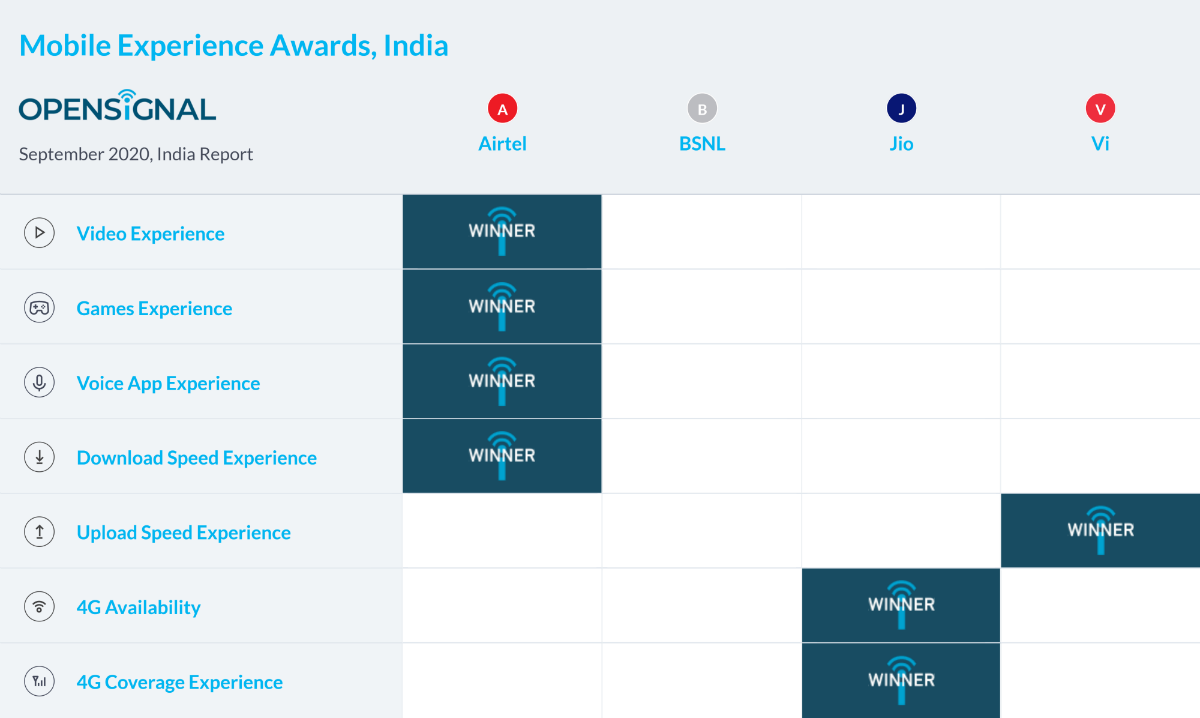
OpenSignal today released its ‘Mobile Network Experience Report September 2020‘ for the Indian market. The report focusses on several factors like gaming experience award, download experience, upload experience, video experience, 4G LTE availability and more. In the September 2020 report as well, Bharti Airtel topped the chart in terms of average download speed and it is closely followed by Vi. OpenSignal, for the first time, also tested mobile gaming experience across different operators in India. The firm also stated Reliance Jio continues to lead the chart in terms of 4G availability, however, Airtel is closing the gap. Continue reading to know more about the state of mobile networks in India during the month of September. Airtel 4G Download Speeds Better Than OthersAs we all know, Vodafone and Idea became a single brand recently and it is the first time OpenSignal has treated them as a single operator- Vi. The network testing firm has examined mobile network experience of the four main mobile network operators in India- Airtel, BSNL, Jio and Vi, over a period of 90 days beginning May 1, 2020. The tests have been conducted across 49 of India’s largest cities. Starting with the 4G download speeds, Bharti Airtel has retained the top spot for the sixth report in a row with a score of 10.4 Mbps. However, Vi is now very close to Airtel as it recorded a speed of 10.1 Mbps. While Airtel saw an increase in average download speeds, the same for Reliance Jio declined by 0.4 Mbps to 6.9 Mbps. BSNL's Download Speed Experience score fell by 0.2 Mbps compared with OpenSignal’s last report to 2.7 Mbps. As for the upload speeds, Vi continues to be the leader and has again won the Upload Speed Experience award in September 2020 report with a score of 3.5 Mbps that’s 0.7 Mbps ahead of second-placed Airtel with 2.8 Mbps. Vi’ score is also 56.1% higher than that of Jio’s (2.3 Mbps) and 4.3 times higher than that of BSNL’s (1.0 Mbps). Airtel Offers the Best Gaming ExperienceAs noted, OpenSignal has assessed the mobile gaming experience for the first time. OpenSignal monitored how the real-time multiplayer gaming experience differs across operators in India. Again, Airtel came out on top and won the OpenSignal Games Experience award with a score of 55.6 out of 100. Vi is slightly behind Airtel with a score of 55.2. OpenSignal says the Games Experience metric is all about the experience when playing real-time multiplayer mobile games on smartphones connected to servers located around the world. The overall score revealed by OpenSignal is based on several parameters including latency (round trip time), jitter (variability of latency) and packet loss (promotion of data packets that never reach their destination). OpenSignal tested the parameters on popular games like Fortnite, Pro Evolution Soccer and Arena of Valor. Lastly, Reliance Jio once again won on the 4G Availability aspect. Reliance Jio has an impressive 98.7% 4G availability and it is closely followed by Bharti Airtel with an impressive 95.6%. Original article: Bharti Airtel Offering Best Gaming Experience in India Followed by Vi: OpenSignal ©2020 TelecomTalk. All Rights Reserved. |
| Tata Sky Introduces 200 Mbps Broadband Plan, Revises 300 Mbps Plan Price Posted: 28 Sep 2020 12:47 AM PDT This post first appeared on TelecomTalk Read more at: https://telecomtalk.info/tatasky-200mbps-broadband-plan-introduction/300942/, Tata Sky Introduces 200 Mbps Broadband Plan, Revises 300 Mbps Plan Price
Tata Sky Broadband, a subsidiary of Tata Sky Limited has introduced a new 200 Mbps unlimited plan at Rs 1050 per month. The operator with its presence in 14 cities across India revamped its broadband plans in the past week with the service provider also enabling its users to avail landline services. In late May, Tata Sky Broadband revamped its service plans with the operator also reducing its Fixed GB plan offerings to four tiers in the majority of the cities where it offered its services. The operator has since reduced its presence across India with its Fixed GB plan currently restricted to one location. Tata Sky Broadband Introduces 200 Mbps Unlimited PlanTata Sky Broadband said that the 200 Mbps unlimited plan is said to be available in "select areas and is subject to technical feasibility." The users subscribed to the 200 Mbps plan priced at Rs 1050 per month excluding taxes will have the speeds restricted to 3 Mbps upon hitting 3300GB data consumption. The operator highlighted that the 200 Mbps plan is available for subscription on a monthly, quarterly, semi-annual and annual basis. The users subscribing to the 200 Mbps plan on a monthly basis are required to pay Rs 500 as installation charges and Rs 1000 as refundable security deposit. However, the users subscribing to the 200 Mbps plan on a quarterly, semi-annual and annual basis are not required to pay the installation charges and refundable security deposit. Tata Sky Broadband highlighted that the users subscribed to the 200 Mbps plan on a monthly and quarterly basis can avail the landline services for Rs 100 per month. The charges for the landline services are said to be waived off to users on the semi-annual and annual packs. The operator has currently listed its 200 Mbps plan in Bengaluru, Chennai, Ghaziabad, Jaipur, Kolkata, Mira Bhayandar, Mumbai, Navi Mumbai, New Delhi, Noida, Pimpri Chinchwad, Pune and Thane. Tata Sky Broadband Revises 300 Mbps PlanTata Sky Broadband has also revised the price point of its 300 Mbps plan said to be available in "select areas." The operator highlighted that the 300 Mbps plan introduced earlier in the year has been revised to Rs 1500 per month exclusive of taxes. The 300 Mbps plan is said to be available on a monthly, quarterly, semi-annual and annual basis. The operator has currently listed the 300 Mbps in Bengaluru, Chennai, Mumbai, Navi Mumbai, New Delhi, Pune and Thane. Tata Sky Broadband has also listed the 300 Mbps plan in Kalyan-Dombivli. However, as of press time on Monday, the 300 Mbps plan in Kalyan-Dombivli currently reflects the previous price point of Rs 1900 per month. Original article: Tata Sky Introduces 200 Mbps Broadband Plan, Revises 300 Mbps Plan Price ©2020 TelecomTalk. All Rights Reserved. |
| Tata Sky to Revise EPG Numbers of Over 20 Bengali Channels Posted: 27 Sep 2020 11:07 PM PDT This post first appeared on TelecomTalk Read more at: https://telecomtalk.info/tatasky-epg-channel-bengali-channels/300904/, Tata Sky to Revise EPG Numbers of Over 20 Bengali Channels
Tata Sky, the largest Direct-to-Home (DTH) operator in India announced that the Bengali regional channels on its platform would have electronic programming guide (EPG) number revisions beginning September 29, 2020. The operator said that the two day exercise ending on September 30, 2020 would affect over 20 Bengali regional channels including Colors Bangla, Zee Bangla and Star Jalsha. The operator since early September has been revising the EPG numbers of over 100 channels on its platform including English entertainment, Kannada, Tamil and Marathi regional channels. Tata Sky Platform Changes to Impact Bengali Regional ChannelsTata Sky announced that 14 Bengali regional channels including Colors Bangla, Zee Bangla, Star Jalsha, Sony Aath, Sun Bangla and Sangeet Bangla will have its EPG revisions on Tuesday. Further, Ruposhi Bangla, Jalsha Movies, Aakaash Aath and Zee 24 Ghanta will also have its EPG revisions on Tuesday. It has to be noted that the EPG number revisions of the Bengali channels on the Tata Sky platform would also impact the high-definition (HD) channels. The operator highlighted that the Colors Bangla HD, Zee Bangla HD, Star Jalsha HD and Jalsha Movies HD will also have its EPG revisions on Tuesday. 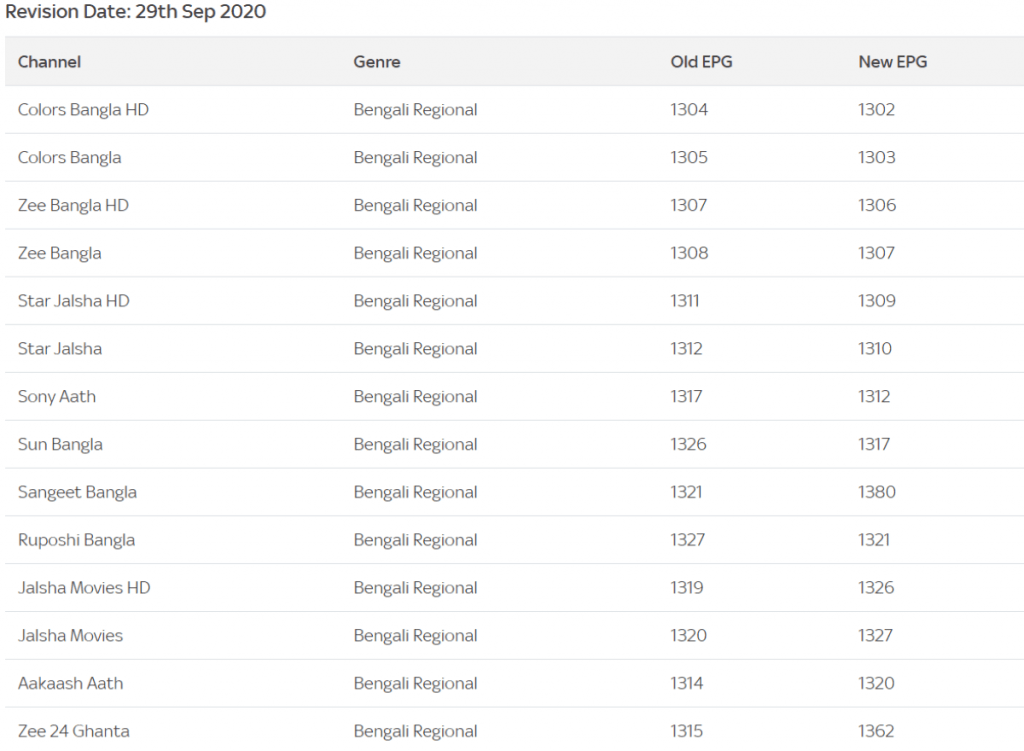 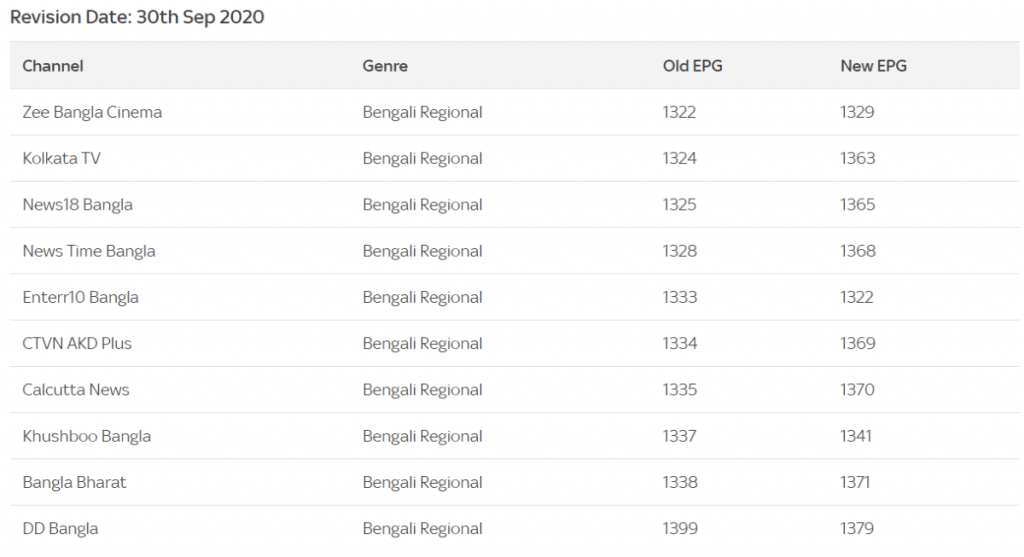 Tata Sky said that 10 Bengali regional channels including Zee Bangla Cinema, Kolkata TV, News 18 Bangla, News Time Bangla, Enterr10 Bangla will have its EPG number revisions on Wednesday. CTVN AKD Plus, Calcutta News, Kushboo Bangla, Bangla Bharat and DD Bangla are other channels scheduled to have its EPG number revisions on Wednesday. Tata Sky Has Revised EPG Numbers of Over 100 Channels Since Early SeptemberThe operator since early September consistently revised the EPG numbers of over 100 channels on its platform English entertainment channels like Star World, Zee Cafe and Colors Infinity. Further, the operator has also revised the EPG numbers of several Tamil, Kannada and Marthi regional channels such as KTV, Star Vijay, Kalaignar TV, Zee Kannada, Udaya Movies, Zee Marathi and Colors Marathi. Tata Sky also moved select Star Sports 1 regional channels to new EPG numbers in the past month. Original article: Tata Sky to Revise EPG Numbers of Over 20 Bengali Channels ©2020 TelecomTalk. All Rights Reserved. |
| Xiaomi Mi 10T and Mi 10T Pro Complete Specs Leaked Online Ahead of Launch Posted: 27 Sep 2020 09:51 PM PDT This post first appeared on TelecomTalk Read more at: https://telecomtalk.info/xiaomi-mi-10t-specs-pricing/300879/, Xiaomi Mi 10T and Mi 10T Pro Complete Specs Leaked Online Ahead of Launch
Xiaomi is all set to launch the Mi 10T series on September 30 globally. While there’s no update on whether the phones will reach the Indian market or not, complete specifications of Xiaomi Mi 10T and the Mi 10T Pro have been leaked online. Both the Mi 10T and the Mi 10T Pro smartphones will have Snapdragon 865 SoC and 5G connectivity on board. It seems like the Snapdragon 865+ SoC will be exclusive to some high-end gaming phones out there. Even the OnePlus 8T is also rumoured to come with Snapdragon 865 itself. The Mi 10T Pro, in particular, will be a standout offering from Xiaomi as it is said to pack 108MP rear-facing camera, massive 5000mAh battery with 33W fast charging and more. Xiaomi Mi 10T Series: Rumoured Specifications and FeaturesAs the names itself suggest, the Xiaomi Mi 10T will be a successor to the Mi 10 5G that was launched in India, whereas the Mi 10T Pro will replace the Mi 10 Pro in global and Chinese markets. Starting with the Mi 10T 5G, the phone is said to sport a 6.67-inch Full HD+ IPS LCD screen with 20:9 aspect ratio. Underneath, it will have the Qualcomm Snapdragon 865 chipset, paired with 8GB of RAM. As for the cameras, the Mi 10T 5G will have a quad camera setup comprising of 64MP primary lens, 13MP ultra-wide-angle lens and a 5MP macro sensor. The phone is tipped to offer a 5000mAh battery, 33W fast charging and a 20MP front-facing camera. Xiaomi is also rumoured to include a side-mounted fingerprint scanner on the Mi 10T 5G. As for the Mi 10T Pro 5G, it is also said to have a 6.67-inch Full HD+ IPS LCD screen and a 20:9 aspect ratio. Majority of the specifications like Snapdragon 865 SoC, up to 8GB of LPDDR5 RAM, 256GB UFS 3.1 storage and a 5000mAh battery with 33W fast charging. The USP of the Mi 10T Pro 5G is said to be the 108MP rear-facing camera which will work in tandem with 13MP ultra-wide-angle lens and a 5MP macro sensor. These specifications are leaked by tipster Sudhanshu. Another highlight of the Mi 10T series would be the 144Hz refresh rate. Yes, Xiaomi is said to include an even high refresh rate screens which could be the reason behind it choosing IPS panels for the flagship series. Multiple rumours on the web are also hinting the Mi 10T Pro 5G will reach the Indian market soon for a price tag of around Rs 35,000. Original article: Xiaomi Mi 10T and Mi 10T Pro Complete Specs Leaked Online Ahead of Launch ©2020 TelecomTalk. All Rights Reserved. |
| JioFiber, Airtel Xstream Fiber and BSNL Bharat Fiber Cheapest Broadband Plans Compared Posted: 27 Sep 2020 06:33 PM PDT This post first appeared on TelecomTalk Read more at: https://telecomtalk.info/jiofiber-bsnl-airtel-cheap-broadband-compared/300748/, JioFiber, Airtel Xstream Fiber and BSNL Bharat Fiber Cheapest Broadband Plans Compared
BSNL yesterday announced new fiber broadband plans for its customers. It is interesting to look at how various internet service providers in the market are ramping up their plans since the time Airtel Xstream Fiber and JioFiber started providing customers unlimited data with cheaper plans. BSNL also launched a broadband plan priced under Rs 500 to make it similar to that of the cheapest plans offered by JioFiber and Airtel Xstream Fiber. So which internet service provider is offering its customers the best cheapest plan? Read ahead to find out. BSNL Rs 449 Broadband PlanThe Rs 449 broadband plan from BSNL is named 'Fibre Basic'. It provides customers with 30 Mbps downloading and uploading speed along with 3.3TB data for the month. Post consumption of FUP data, the speed drops to 2 Mbps. Customers who want to purchase this plan for long-term don't have the option to do so for now. There is unlimited calling included with the plan. The customer will have to pay Rs 500 as installation charges and if you are looking for OTT benefits with your broadband plan, there is none with this one. JioFiber Rs 399 Broadband PlanJioFiber launched its Rs 399 broadband plan a few weeks back and named it 'Bronze'. This plan also provides the customer with 30 Mbps downloading and uploading speed. On top of this, the customer also gets 3.3TB data per month and unlimited calling. After the FUP data is consumed, the speed drops to 1 Mbps. There are no OTT benefits included with the plan and the customer needs to pay Rs 1,000 as installation charges. Airtel Xstream Fiber Rs 499 Broadband PlanThe Airtel Xstream Fiber Rs 499 broadband plan is named 'Unlimited'. This plan offers its customers unlimited data which is 3.3TB for the month along with 40 Mbps downloading and uploading speed. On top of this, the customers also get unlimited calling and OTT benefits (Airtel Xstream Premium, Wynk Music, Shaw Academy, Voot Basic, Eros Now, Hungama Play, Shemaroo Me, Hoichoi, and Ultra). If the customers go for the monthly plan, then they have to pay Rs 1,000 as installation charges. But if they choose to go with any of the long-term plans (3, 6, and 12 months), then they will be exempted from any installation charges. VerdictSo to decide which one is better, it is quite clear that Airtel Xstream Fiber customers get the most value out of their broadband plan. Airtel Xstream Fiber's cheapest plan offers OTT benefits whereas the cheapest plans from BSNL and JioFiber don't. Adding to that, the 3.3.TB data offered by Airtel is actually 3,333GB data which is more than the 3.3TB data (3,300GB) which JioFiber and BSNL offer. Along with that, Airtel offers 40 Mbps downloading and uploading speed which is faster than the BSNL's and JioFiber's 30 Mbps. Yes, JioFiber is Rs 100 cheaper compared to the Airtel's plan, but the most value still lies with the Airtel's plan. Original article: JioFiber, Airtel Xstream Fiber and BSNL Bharat Fiber Cheapest Broadband Plans Compared ©2020 TelecomTalk. All Rights Reserved. |





| You are subscribed to email updates from TelecomTalk. To stop receiving these emails, you may unsubscribe now. | Email delivery powered by Google |
| Google, 1600 Amphitheatre Parkway, Mountain View, CA 94043, United States | |


Comments
Post a Comment