${latestitem Title}
${latestitem Title} |
- Google Tensor Chip Might See a Second Generation Upgrade Next Year
- Airtel Digital TV HD STB With 132 Channels Available for Rs 1692
- Broadband Internet Can Help 4G Networks
- How Telecom Sector Is Contributing to Industrial Revolution 4.0
- Vodafone Idea VoWi-Fi Calling Support Extended to New Region
| Google Tensor Chip Might See a Second Generation Upgrade Next Year Posted: 31 Oct 2021 08:46 AM PDT  Google recently launched the Pixel 6 and Pixel 6 Pro handsets with tensor mobile SoC, and now a report has claimed that Google is working on a second-generation tensor SoC which will be likely to be shipped with the Pixel 7 series. The Pixel 6 and Pixel 6 Pro have formally launched and are introduced with Google's new line of Tensor chips. Created with the help of Samsung, the Google Tensor is optimised for google's extensive use of machine learning, accelerating existing features and enabling things that can't be done on the phone before. Google recently launched the Pixel 6 and Pixel 6 Pro handsets with tensor mobile SoC, and now a report has claimed that Google is working on a second-generation tensor SoC which will be likely to be shipped with the Pixel 7 series. The Pixel 6 and Pixel 6 Pro have formally launched and are introduced with Google's new line of Tensor chips. Created with the help of Samsung, the Google Tensor is optimised for google's extensive use of machine learning, accelerating existing features and enabling things that can't be done on the phone before. Google Tensor 2 Already Spotted9To5Google has spotted a reference to a new pixel related codename, "Cloudripper". A similar codename appeared earlier this year, "Slider", for the Pixel 6 and Pixel 6 Pro. According to 9To5Google, Cloudripper is connected to the second generation version of Google Tensor chips, with the model number "GS201". In comparison to the "GS101" found in the Pixel 6 and Pixel 6 Pro, this chip appears to be full generation power of the google tensor chips, suggesting each year model number will increase by 100. After coming out with the quarterly results during the earnings call, Alphabet and Google CEO Sundar Pichai said the new Pixel 6 series and the new Google Tensor chip lay a good foundation. The new Pixel 6 and Pixel 6 Pro bring out the best of google artificial intelligence (AI), hardware and software, with the most advanced and inclusive cameras the company has ever built. Reports suggest that the Google-designed Tensor SoC that powers both Pixel 6 and Pixel 6 Pro beats the Qualcomm Snapdragon 888, Samsung Exynos 2100, and HiSilicon Kirin 9000 chipsets in GPU benchmarks. The Tensor chipsets give the control back to Google when it comes to optimising its Pixel devices for performance. This will also allow Google to control the manufacturing of the chipset as it won't have to depend on Qualcomm for its chipsets anymore. |
| Airtel Digital TV HD STB With 132 Channels Available for Rs 1692 Posted: 31 Oct 2021 04:30 AM PDT 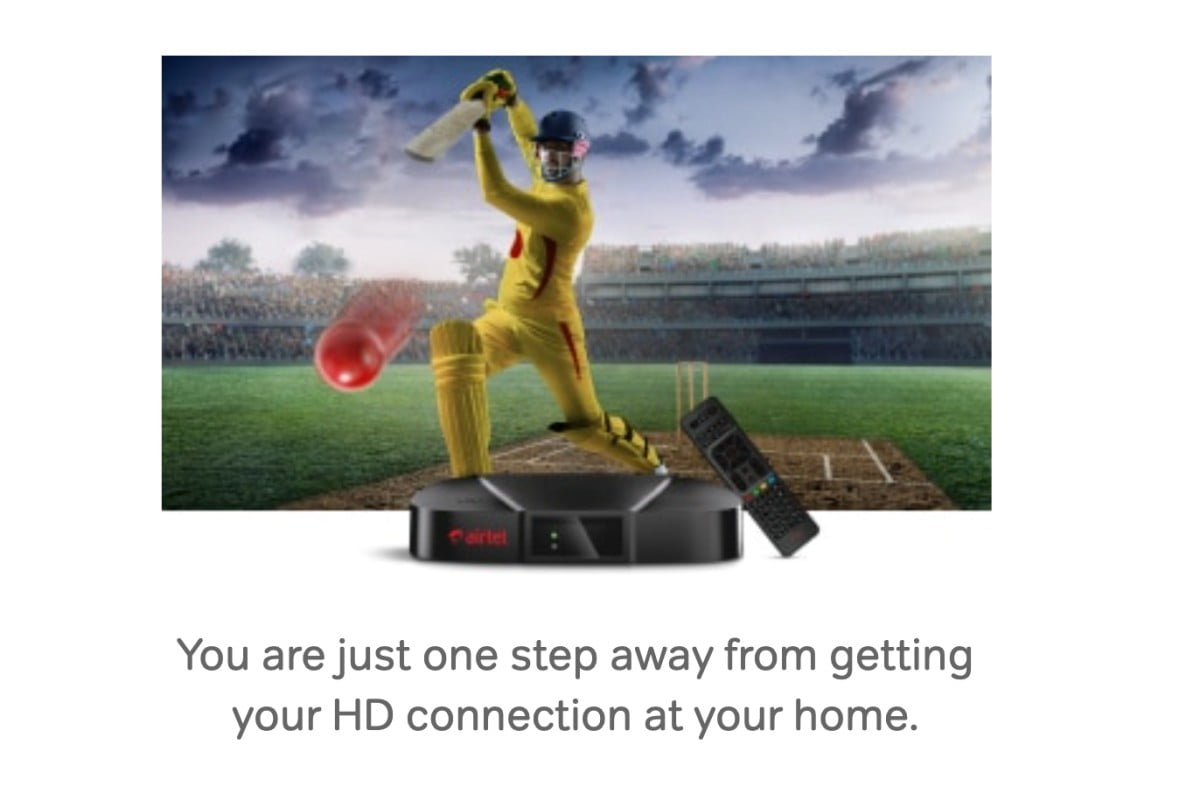 Bharti Airtel's Direct-to-Home (DTH) service arm, Airtel Digital TV, is offering its Set-Top Box (STB) for a mere price of Rs 1,500. But that is not all the cost that a consumer has to pay when he/she purchases a new STB from the company. Users also need to recharge with a channel pack if they want to keep the STB active. So the company also allows users to purchase a channel pack when they are paying for the STB. Moreover, Airtel Digital TV is offering a 10% discount to users if they are purchasing the HD STB online. Bharti Airtel's Direct-to-Home (DTH) service arm, Airtel Digital TV, is offering its Set-Top Box (STB) for a mere price of Rs 1,500. But that is not all the cost that a consumer has to pay when he/she purchases a new STB from the company. Users also need to recharge with a channel pack if they want to keep the STB active. So the company also allows users to purchase a channel pack when they are paying for the STB. Moreover, Airtel Digital TV is offering a 10% discount to users if they are purchasing the HD STB online. Airtel Digital TV HD STB PriceThe Airtel Digital TV under an offer can be purchased for Rs 1692, which includes a 10% discount. The original cost of the STB was Rs 1500. On top of that, you can add a channel pack of Rs 356 per month. This channel pack comes included with 132 channels. The cost of Rs 356 also includes Rs 153 network capacity fee (NCF). So the total cost of the plan becomes Rs 1500 + Rs 356, which is Rs 1856. However, after applying the 10% discount, the price drops to Rs 1,692. Further, the company offers a 1-year warranty worth Rs 100 absolutely for free.Airtel Digital TV HD STB FeaturesThere isn't a lot that you will get with the Airtel Digital TV HD STB. Of course, you will be able to view HD channels. At the same time, the HD STB enables Dolby Digital Sound, which will allow you to get a completely enhanced viewing experience. Users can also record their favourite content and play it later. If you want to go for an even better option and have extra capacity to spend, you can check out Airtel Digital TV's Android STB, namely, Xstream Box. Click here for knowing about all the Xstream Box plans available in the market today. |
| Broadband Internet Can Help 4G Networks Posted: 31 Oct 2021 01:37 AM PDT  Because of the increasing number of 4G users in India and insufficient network capacity, the experience of 4G internet isn't great for many around the country. The problem becomes more evident during the peak hours when many users flock to use the unlimited data they get from their respective telecom operators. While Reliance Jio, Bharti Airtel, and Vodafone Idea (Vi) all are investing heavily in increasing the coverage and network capacity, the 4G performance won't become great overnight. But there's one thing that can help these telecom operators – broadband internet. Fiber broadband connection at every home can change how Indians perceive 4G. Because of the increasing number of 4G users in India and insufficient network capacity, the experience of 4G internet isn't great for many around the country. The problem becomes more evident during the peak hours when many users flock to use the unlimited data they get from their respective telecom operators. While Reliance Jio, Bharti Airtel, and Vodafone Idea (Vi) all are investing heavily in increasing the coverage and network capacity, the 4G performance won't become great overnight. But there's one thing that can help these telecom operators – broadband internet. Fiber broadband connection at every home can change how Indians perceive 4G. Fiber Broadband Can Reduce Load of 4G NetworksFiber broadband internet can help the telecom operators significantly. 4G networks won't be overloaded if users are leveraging fiber broadband whenever they are inside their homes. With broadband connections, users get stable internet speeds, can browse all day with unlimited data, and also get their work done. The issue is, whenever a large number of people are using data in the same area and are consuming services from the same operator's mobile network, it can lead to congestion. This degrades the network experience for the users. Even after paying considerate amounts of money for prepaid/postpaid plans, you can't use the internet properly because of bad download speed. This is why the telecom service providers must ensure that they are availing their users with at least one great entry-level broadband plan. This will mean that users will only have to use mobile data whenever they are outside their homes. Further, if the need for mobile data is less, operators can offer the same amount of data for more money or less amount of data for the same money they are charging right now. This is because most of the users won't care about the expensive data since they are getting unlimited data from their broadband connection. It will help the operators with increasing their average revenue per user (ARPU) figure. Users will only have to use their mobile data whenever they are stepping outside their homes. The expansion and larger adoption of fiber broadband in rural as well as urban areas of the country will ensure that 4G networks are never overloaded. Fiber broadband has even gained popularity during the pandemic and the continuous lockdowns. Most of the users working from their homes in urban cities or even tier-3 cities are relying on their fiber broadband connection for getting their work done. They are further leveraging the broadband connection for their entertainment needs without any worry since they get unlimited data. |
| How Telecom Sector Is Contributing to Industrial Revolution 4.0 Posted: 30 Oct 2021 10:42 PM PDT  By Mr Shashank Agarwal, M.D at Salasar The Indian telecom sector has come a long way after its privatisation in the early 1990s and has seen staggering growth in the past three decades. Though it witnessed a significant slowdown in the early 2010s, the last five years have been remarkable for the industry with exponential growth in the number of users and internet penetration, with over 560 million Indians having access to the internet. Telecom operators are emerging with robust strategies for market share and customer acquisition to keep the sector moving on the digital trajectory. According to a media report, the sector has become the key to India reaching its GDP goal of $5 trillion by 2024. Since the entry of Jio in 2016, the competition in the telecom sector has become fierce, which is playing a crucial role in realising India's digital ambitions. With competition in the telecom sector, access to data services is increasing at a fast pace. Telcos have rapidly expanded from metropolitan to tier 2 & 3 cities, giving internet access to millions of people. Furthermore, this intense competition amongst the telecom operators has led them to offer their services at cut-throat prices and spend big on the development of their own infrastructure, which has made the buy-in cost humongous for any new player to enter the sector. Furthermore, the Indian telecom sector offers one of the world's cheapest data and calling services that have made only prominent telcos compete in the market. By Mr Shashank Agarwal, M.D at Salasar The Indian telecom sector has come a long way after its privatisation in the early 1990s and has seen staggering growth in the past three decades. Though it witnessed a significant slowdown in the early 2010s, the last five years have been remarkable for the industry with exponential growth in the number of users and internet penetration, with over 560 million Indians having access to the internet. Telecom operators are emerging with robust strategies for market share and customer acquisition to keep the sector moving on the digital trajectory. According to a media report, the sector has become the key to India reaching its GDP goal of $5 trillion by 2024. Since the entry of Jio in 2016, the competition in the telecom sector has become fierce, which is playing a crucial role in realising India's digital ambitions. With competition in the telecom sector, access to data services is increasing at a fast pace. Telcos have rapidly expanded from metropolitan to tier 2 & 3 cities, giving internet access to millions of people. Furthermore, this intense competition amongst the telecom operators has led them to offer their services at cut-throat prices and spend big on the development of their own infrastructure, which has made the buy-in cost humongous for any new player to enter the sector. Furthermore, the Indian telecom sector offers one of the world's cheapest data and calling services that have made only prominent telcos compete in the market. Key Drivers Accelerating Digitisation of the SectorThe accelerated process of digital transformation induced by COVID-19 has made the telecom sector the key enabler for digital connectivity. There is a paradigm shift to digital payments like UPI, and the wider acceptance of online shopping and delivery services are being enabled by the telcos. Apart from the consumers, those offering online services and accepting digital payments also require digital connectivity. Thus, the operators are not missing out on this golden opportunity with a focus to generate additional revenue. Due to the pandemic-induced lockdown and stringent social distancing norms, the adoption of digital solutions has accelerated India’s approaching its industrial revolution 4.0. Considering the pace at which the country is undergoing a digital revolution, the launch of 5G becomes critical in the successful adoption of industry 4.0 as it requires the real-time communication and processing of data through a connected network of things which is only possible through a 5G network. Being a next-generation technology without the limitations of 4G, 5G will enable more innovative uses of artificial intelligence, Internet of Things, Automation, Big Data, etc., to help telcos provide customised solutions to customers and enterprises. These solutions run on robust internet infrastructure that has pushed telcos to expand their services and offer unconventional support. Thus, increased adoption of 5G devices and cloud systems will drive digital innovation of the sector at a faster pace.Affordability and ConnectivityConnectivity in India was in a very bad state in the pre-Jio era. Even in metro cities, there were several call drops every minute due to limited network availability. When Jio entered the telecom market, it exploded the consumption of mobile networks at rock-bottom data and voice call prices. This started shrinking the revenues of rival operators like Airtel, Vodafone and BSNL, further making them step up their game. As a result, all three prominent operators started focusing on increasing the bandwidth of their networks to handle the traffic more efficiently with an increased focus on affordability.Roadblocks in the IndustryThough the smart devices market is already supporting 5G services, the fact cannot be ignored that India is still dominated by low-priced smartphones. People are already satisfied with the speed of 4G services that are now being offered at a reasonable price. In the middle of this, there will be a slow transition from 4G to 5G, mainly in tier 2 and 3 cities. That's where the government needs to intervene and provide incentives for telcos to develop an infrastructure away from the metros. The intense financial requirements for being a telecom provider are considered one of the biggest roadblocks in the industry. Telecom company like Vodafone Idea is already losing its subscribers and not generating enough revenue. Another matter surrounds AGR, i.e. Adjusted Gross Revenue that arose when telcos were required to pay a massive fee for telecom license, and most of them did not have the financial muscle to make the upfront payment. As a solution, the government adopted a model to take a small cut from the revenue of the operators that further included cuts from non-telecom revenue interest income, profits from selling old buildings and other miscellaneous incomes. This has created a ruckus in the industry and resulted in making the government rework on their approach to calculating AGR in the recent telecom bailout package. As a relief to telcos, the government has announced its rescue plan with a four-year moratorium on AGR and spectrum dues that Vodafone Idea has to pay the DoT. It has given hope to Vodafone India to survive and compete in the market, which will prevent the industry from slipping into a duopoly of Jio and Airtel.What's Next?The entry of the 4G spectrum accelerated the speed of streaming and showed users the potential of a connected world. It is expected that 5G will bring large-scale disruption in each business sector and will be the backbone of Industry 4.0. Though there will be several roadblocks and challenges, the adoption of 5G will be significant to achieve the Aatmanirbhar Bharat mission-driven by a digitally transformed India. |
| Vodafone Idea VoWi-Fi Calling Support Extended to New Region Posted: 30 Oct 2021 06:34 PM PDT  Vodafone Idea (Vi) is trying to expand the support for voice-over Wi-Fi (VoWi-Fi) calling to as many parts of the country as possible. The telco has been activating the VoWi-Fi service in phases in select regions of India. Now, Vi has added yet another region to its list for VoWi-Fi support. Up until now, Kolkata, Maharashtra & Goa, UP East, Delhi, Gujarat, Rajasthan, and Mumbai were on the list of the company to get support for VoWi-Fi service. However, Vi's website suggests that the service is now also available in the Rest of Bengal. This means that the users in Bengal would now be able to access VoWi-Fi calling from their smartphones. However, it is not just a new region, but the company is now also offering Wi-Fi calling support for new smartphones. Vodafone Idea (Vi) is trying to expand the support for voice-over Wi-Fi (VoWi-Fi) calling to as many parts of the country as possible. The telco has been activating the VoWi-Fi service in phases in select regions of India. Now, Vi has added yet another region to its list for VoWi-Fi support. Up until now, Kolkata, Maharashtra & Goa, UP East, Delhi, Gujarat, Rajasthan, and Mumbai were on the list of the company to get support for VoWi-Fi service. However, Vi's website suggests that the service is now also available in the Rest of Bengal. This means that the users in Bengal would now be able to access VoWi-Fi calling from their smartphones. However, it is not just a new region, but the company is now also offering Wi-Fi calling support for new smartphones. Vodafone Idea VoWi-Fi Calling Available for New SmartphonesThis, of course, has to include the new iPhone series that launched recently. All the devices in the iPhone 13 series can support Vodafone Idea's VoWi-Fi calling. All the iPhones, including iPhone 6s, iPhone 6s Plus, and so on, can support VoWi-Fi calling. Smartphones from other brands, including OnePlus, Oppo, Samsung, Realme, and Xiaomi, also support the Wi-Fi calling service from Vi. It is unfortunate to see smartphones from brands such as Vivo and iQoo not included in the list. The new Reno6 series from Oppo supports Vi's Wi-Fi calling. If you have a smartphone from one of these brands and you want to know whether your device supports Vi Wi-Fi calling, you can go to the company's website. Vodafone Idea VoWi-Fi calling service is available for each and every eligible postpaid and prepaid customer of the telco. The good thing is, there's no additional charge for the consumers if he/she is on an unlimited voice calling pack. But of course, you will need a strong Wi-Fi connection for which you need to pay. The VoWi-Fi calls will consume data provided by your broadband connection.How to Activate Wi-Fi Calling on Vi?If you want to know how you can activate the Wi-Fi calling service if you are a Vodafone Idea user, follow these steps. 1. Connect your device with a stable and fast Wi-Fi network. 2. Ensure that your smartphone supports Vi's VoWi-Fi calling service and is also updated. 3. There must be a 4G SIM of Vi inside your smartphone. 4. Go to Settings on your device and turn on the Wi-Fi calling switch. The steps will be different for both iOS and Android users. But the Wi-Fi calling switch will be inside settings and then network settings for Android users, while for iOS users, it will be Settings > Phone > Wi-Fi calling. One thing that you must ensure is that both VoLTE and Wi-Fi calling should be switched on in your device when you are trying to make a VoWi-Fi call. The benefit of VoWi-Fi calling is that users can make crystal clear calls despite being in a bad network zone. |
| You are subscribed to email updates from TelecomTalk. To stop receiving these emails, you may unsubscribe now. | Email delivery powered by Google |
| Google, 1600 Amphitheatre Parkway, Mountain View, CA 94043, United States | |


Comments
Post a Comment