${latestitem Title}
${latestitem Title} |
- Bharti Airtel Brings Smart Missed Call Alerts for Users
- TelecomTalk June 2022 Tariff Hike Poll: One-Third Users Comfortable with Higher Tariffs
- Telegram Premium Confirmed for this Month, Should You be Worried
- Explained: Apple Passkeys Will Remove Existence of Passwords
- DoT Sets Up Internal Committee to Deliberate Over Private 5G
- Reliance Jio Most Affordable 1GB Daily Data Prepaid Plan
- Airtel, Jio and Vi Need the Govt to Side with Them to Make 5G Successful
| Bharti Airtel Brings Smart Missed Call Alerts for Users Posted: 11 Jun 2022 06:27 PM PDT
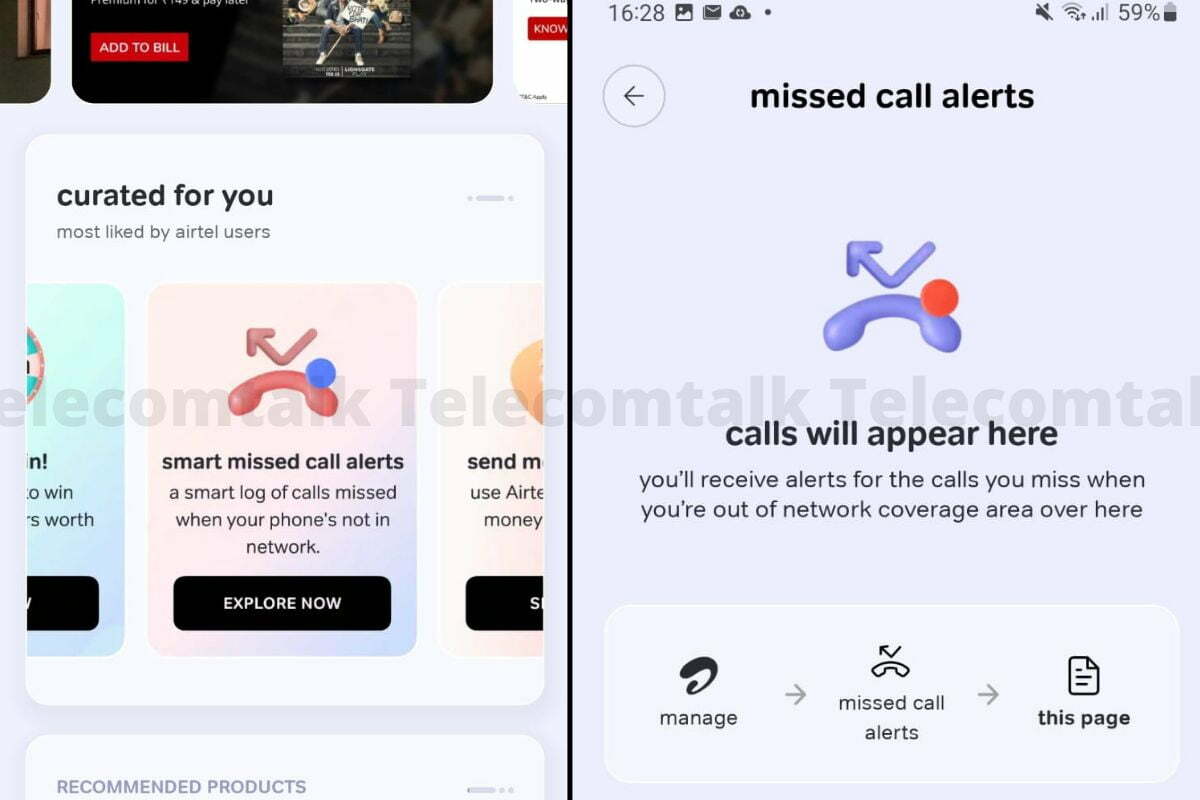
Bharti Airtel, the second-largest telecom operator in the country has brought 'Smart Missed Call Alerts' for users. With this feature, users will be able to see the missed call alerts when their SIM is out of network coverage. It is not a unique feature and is something that Jio users already get. Airtel Smart Missed Call alerts will be visible for the users when they go to the Airtel Thanks app and find the Missed Call Alerts section. It is actually a much-needed service that the telco's users will definitely appreciate. Sometimes we miss out on very important calls due to the mere fact that we are out of network coverage and then never even get to know about them as we didn't hear the ringtone nor see a notification of missed call on the calling app. But with the Smart Missed Call Alerts, users will be able to see every call they missed out on when their SIM was out of network coverage. Airtel Customers Who Can Use Smart Missed Call Alerts FeatureIf you are an Airtel mobile customer, then whether you are a prepaid user or a postpaid user, you will be able to leverage the Smart Missed Call feature from the Airtel Thanks app. Any Airtel user with an active voice calling connection can benefit from this feature regardless of the kind of plan they are subscribed to. As mentioned above, Reliance Jio users get this service already. Jio notifies its customers that they had a missed call when their device was out of coverage through direct SMS which is more convenient than going to a mobile app to check it every time. If you are not an Airtel customer and want to become one, just visit any of the nearest retail stores of the company or order it online through the official website of the telco. You can get a new SIM from the comfort of your home. |
| TelecomTalk June 2022 Tariff Hike Poll: One-Third Users Comfortable with Higher Tariffs Posted: 11 Jun 2022 07:42 AM PDT
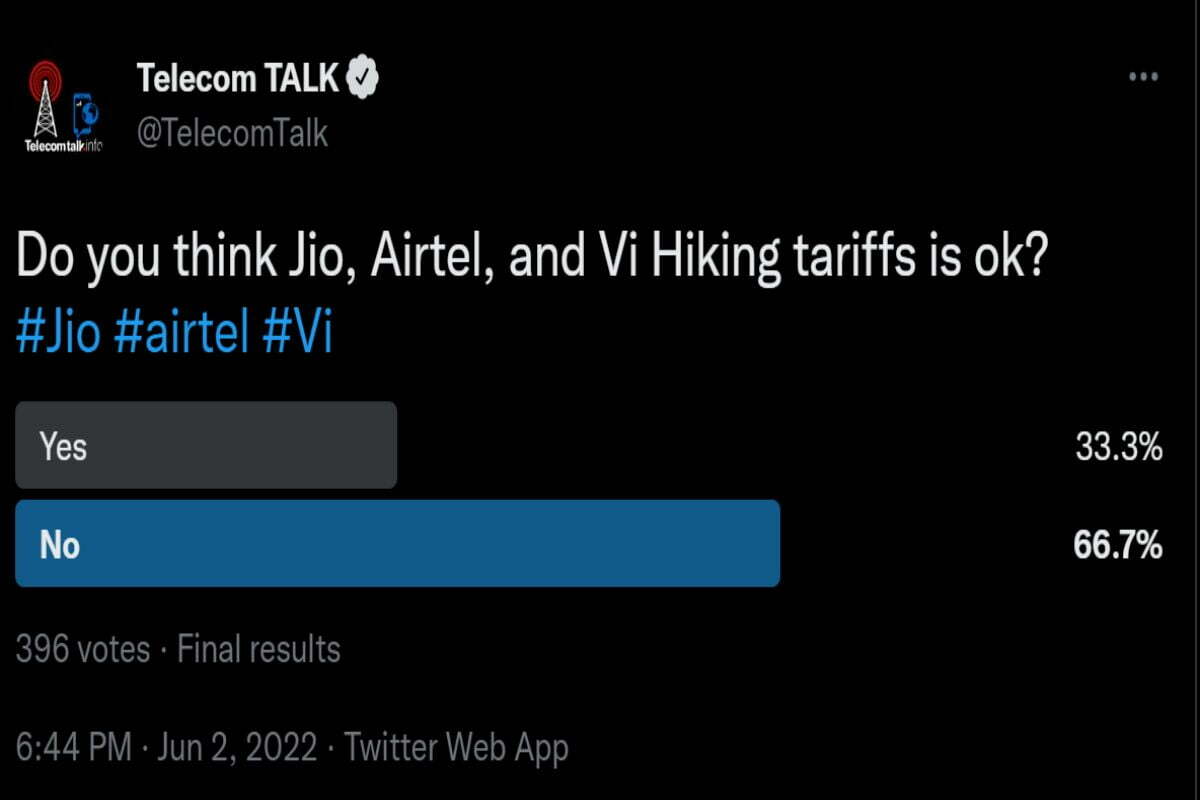
TelecomTalk conducted a short survey/poll on its official Twitter handle around tariff hikes that Jio, Airtel, and Vi (Vodafone Idea) implemented. A total of 396 votes came in this short survey. After the closing of the poll, over 33.3% or one-third of the voters said that they were okay with the tariff hikes from the private telcos. But the remaining 66.7% of voters said that they weren't okay with the tariff hikes. This is interesting data as the telcos state that they want to go with another round of tariff hikes. A Twitter user with the handle @vshalsopariwala replied to the poll tweet that since the fuel costs are rising, then why not the telecom companies increase the cost of their services? The last round of tariff hikes came in December 2021. Private telcos, including Bharti Airtel and Vodafone Idea (Vi), have been very vocal about raising tariffs again in 2022. It will be interesting to see how the telcos will justify another tariff hike without actually improving network coverage and performance. Rising Data Costs Will Push People to Opt for BSNL PlansBSNL (Bharat Sanchar Nigam Limited) is the only telco that hasn't gone for any direct tariff hikes in the last few years. That could be one of the reasons why the telco added new active users for consecutive months in 2022. While the telco is working on rolling out 4G networks, it is unlikely that it will hike the tariffs to the level of what the private telcos offer to their consumers. This will make users choose BSNL over every other operator as the secondary SIM option. Otherwise, maintaining an active secondary SIM would become too costly for the users, and India might again become a county with maximum people owning just a single SIM card. Due to cheap data rates from Jio followed by other telcos, the era of two-SIM cards for everyone has been running for the last few years. |
| Telegram Premium Confirmed for this Month, Should You be Worried Posted: 11 Jun 2022 05:21 AM PDT
Telegram is one of the most widely used chatting applications globally after WhatsApp. Even Telegram has more than a billion downloads like WhatsApp, a feat that can't be ignored by anyone. When the company first arrived on the scene, it said to the users; we are never going to charge you. But that's changing later this month as Telegram will launch a Premium subscription of the application for users. Here's everything you should know about this. Telegram Premium DetailsTelegram will continue to offer the existing features of the app for free, said Pavel Durov, founder of Telegram. In an official announcement, Durov said that Telegram couldn't remove all limits to offering a better user experience as it would scale the server and traffic costs to an unmanageable level. Thus, the company is building a Premium model for users who are ready to pay a little to get more out of the app. Durov said that Telegram Premium is a subscription plan that will allow users to acquire additional features, speed and resources. Further, the users on the Premium plan will get the new features before everyone else. Durov asked users not to worry as the existing features will continue to come for free, and the company will keep adding new features at regular intervals. Even users who are not on the Premium plan of Telegram will be able to benefit from it indirectly as they will be able to view media and stickers along with extra-large documents sent by the Premium users. The main reason for charging users is to keep the focus on what users need rather than going to the advertisers and losing focus on the consumers, said Telegram. The Premium model would allow Telegram to keep its priorities straight. Details around the pricing of the premium model aren't out right now. Also, whether the Premium subscription would arrive in each country together is unknown. |
| Explained: Apple Passkeys Will Remove Existence of Passwords Posted: 11 Jun 2022 02:09 AM PDT
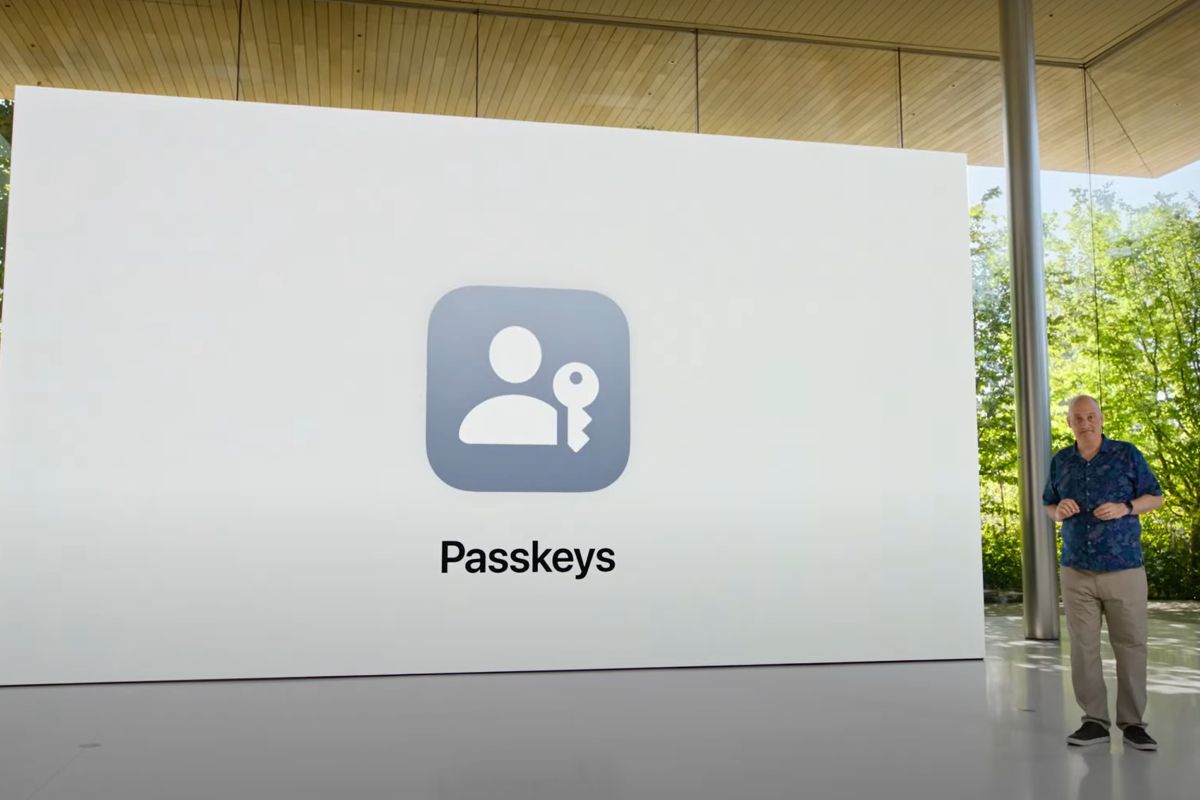
On the first day of the World-Wide Developers Conference (WWDC) 2022, Apple announced Passkeys. The company said that Passkeys are a replacement for passwords to sign in on websites and apps. Not just a replacement, but they are faster, secure, and much easier to use. One of the major benefits of Passkeys is that they are not prone to phishing-like passwords. Apple has designed Passkeys to work across all of its devices including the non-Apple devices within physical proximity. Passkeys are built on the WebAuthentication standard using Public Key Cryptography. When the user is registering an account, the operating system of the Apple device will create a unique cryptographic pair for associating with an account for the website or the app. One of the keys will be stored on a private server while the other one will be public and not secret at all. However, to log in to the account, a private key will be needed. Also, Apple has ensured that the private key is never learned by the server. Apple Leverages Face ID and Touch ID for PasskeysApple devices which come with support for either Face ID or Touch ID or both can be leveraged to authorise the use of Passkey. The device’s security system can act as a way to authenticate the user to the website or the app. Apple said the server doesn't need to protect the public key. The great thing about being in an Apple ecosystem of products is that iCloud can help with synchronising the experience and activities between multiple devices. The Passkeys have been designed by Apple to leverage the iCloud Keychain for syncing across a user's multiple devices. This means that users can authenticate login in multiple devices using the same Passkey if their iCloud ID is active in them. Apple is not only making sure that its users have a safe experience, but also creating an ecosystem lock that would want the users to stay with Apple products. |
| DoT Sets Up Internal Committee to Deliberate Over Private 5G Posted: 11 Jun 2022 12:06 AM PDT
The Department of Telecommunications (DoT) has set up an internal committee for discussing the matter of private 5G networks. The telcos and the tech companies have differing views on the topic, and that's why the government's call on things will be very important. According to an FE report, the DoT is going to discuss the needs, timing, possible models, pricing and more around the private 5G networks. Then the committee will send its report to the Telecom Regulatory Authority of India (TRAI), which will then vet it and add its own set of recommendations. This would enable a holistic policy to be developed around private 5G networks. 5G Spectrum Auction to Take Place Soon, But the Private 5G Discussions to Go OnThe Cabinet is soon going to reveal its decision around different elements of the upcoming 5G spectrum auction. But the body will only confirm the concept of private 5G networks and say that the other details surrounding it will be given later. The details would only come when the government and the TRAI work out the details. However, the telcos will be on the lookout for the decision that TRAI and the government will take. This is because they are counting on providing private 5G network services to increase revenue potential. If the decision goes against them, we might see a different 5G story in India altogether. It is worth noting that in its recommendations, TRAI had said that the enterprises could be given spectrum directly by the government for private 5G, or they could lease it from the telcos or get the networks built by the operators only. There are a lot of "ifs" around the matter and no clearance at all. It will be crucial for the telcos to know what kind of fate awaits them in the domain of private 5G before they step into the spectrum auctions for spending thousands of crores. |
| Reliance Jio Most Affordable 1GB Daily Data Prepaid Plan Posted: 10 Jun 2022 09:52 PM PDT
Reliance Jio, the largest telecom operator in the country, offers multiple prepaid plans to users. There are affordable options as well as expensive options. If you are looking for a very affordable plan under Rs 200 which can also offer a decent amount of data, you can definitely go for the 1GB daily data plan of Jio that comes for Rs 179. However, this plan doesn't come with a long validity. Let's take a look at the complete benefits offered by this Jio plan. Jio Rs 179 Prepaid Plan DetailsReliance Jio offers its Rs 179 prepaid plan with 1GB of daily data for 24 days. In addition to this, Jio offers unlimited voice calling and 100 SMS/day benefits. Users also get a free subscription to JioTV, JioCinema, JioCloud, and JioSecurity. Post the consumption of FUP (Fair-Usage-Policy) data; the speed drops to 64 Kbps. But this is not the most affordable 1GB daily data plan offered by the telco. There's another prepaid plan that offers the same benefit as the Rs 179 plan but for 20 days. This plan costs Rs 149. Jio Rs 149 Prepaid Plan DetailsReliance Jio offers its Rs 149 prepaid plan with 100 SMS/day, unlimited voice calling, and 1GB of daily data for 20 days. Users get the same subscriptions as offered with the Rs 179 plan. This plan is made for people who can't spend a lot on mobile recharges. The data speed drops to 64 Kbps once the FUP data has been consumed by the user. If you want the same plan with slightly longer validity, you can go for the Rs 209 option. With this plan, users get active service validity of 28 days with 1GB of daily data and all the same benefits as the Rs 149 and the Rs 179 prepaid plans. These are some of the truly affordable prepaid plans in India right now, backed with a 4G network. |
| Airtel, Jio and Vi Need the Govt to Side with Them to Make 5G Successful Posted: 10 Jun 2022 06:37 PM PDT
Bharti Airtel, Reliance Jio and Vodafone Idea (Vi) are going to need the government at their side when the discussion of private 5G networks comes around. The telcos have demonstrated many use cases around 5G. But the common theme amongst most of these use-cases was that they were built for enterprises. The consumer-focused use cases were rare, and it makes sense because consumers just need to browse the internet, stream videos, play games, and do video calls – all of which can be done via a strong 4G network. The telcos have been planning for the 5G spectrum auction and must already know the kind of airwaves they want for rolling out commercial 5G networks. But things might go a little bad for the telcos if the government doesn't side with them. There's a big battle over private 5G going on between the telcos and the tech companies. The tech companies want the government to do administrative allocation of airwaves for private 5G networks. This, however, the telcos don't like. Cellular Operators Association of India (COAI), the representative body of the private telcos, wrote to Ashwini Vaishnaw, Minister for Communication, saying that the government must go through the auction route for spectrum allocation, and it should be only provided to the licensed access service providers. This will be to ensure that the telcos can see their revenues growing by setting up private 5G networks for the enterprises. COAI said that if the telcos are ignored, and the administrative allocation of airwaves happens, there would be no viable business case for rolling out 5G. The industry body representing the telcos cited global data and said that incremental revenues only come from 5G with the enterprise services. If the telcos see that their enterprise services won't be required in India related to 5G, they might not go for a commercial rollout. Here, the Broadband Forum India (BIF), the body which represents tech companies such as Microsoft and more, said that what the telcos are saying is not correct. Rubbishing the claims made by COAI, BIF suggested that there's an untapped channel of revenues that the telcos will get when the enterprises are allocated spectrum in an administrative manner. BIF claimed that there are no security concerns with allowing enterprises to set up their own networks using spectrum reserved for them. Further, as per BIF, the Indian telcos would gear their 5G networks for the masses, and thus it won't benefit the enterprise to take services from them. Which Side Will the Government Lean?Well, it is hard to say right now, but the Department of Telecommunications (DoT) doesn't want the airwaves to be directly allocated to the enterprises. However, the final call doesn't rest with the DoT but instead with the Cabinet, which is yet to give its decision on the matter. The telcos have said that they can offer the desired services to the enterprises, but according to BIF, the tech companies are the best qualified for setting up their own private networks. Things will only clear up once the Cabinet comes out with its final decisions. |


| You are subscribed to email updates from TelecomTalk. To stop receiving these emails, you may unsubscribe now. | Email delivery powered by Google |
| Google, 1600 Amphitheatre Parkway, Mountain View, CA 94043, United States | |


Comments
Post a Comment